

Corda compares your domain with your competitors and shows you exactly how far ahead they are and by how much.
This page explains how to read that comparison so it leads to a decision, not just a number to feel behind on.
What The Panel Shows You
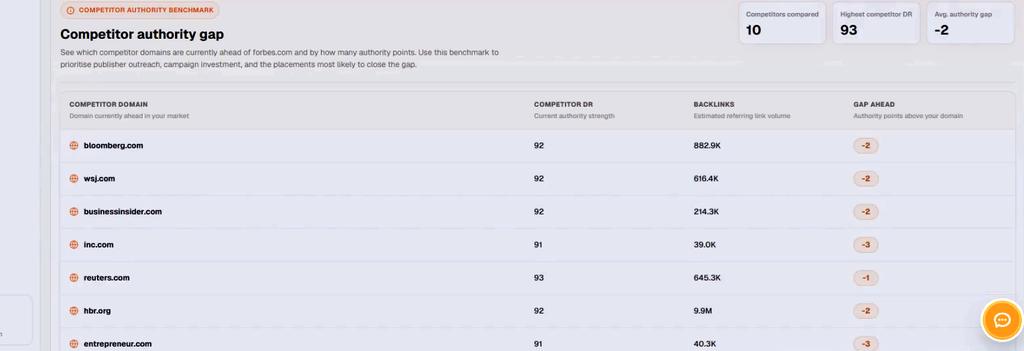
The Competitor Authority Gap panel gives you three summary numbers first:
- Competitors compared: how many competitor domains were included
- Highest competitor DR: the strongest authority score among them
- Average authority gap: how far you sit from them on average
Below that, a table lists each competitor domain with its authority strength, its estimated backlink volume, and how many authority points it’s ahead of you by.
Don’t Rank Competitors By Their Score Alone
It’s tempting to look at the table and go straight for whoever has the highest DR. That’s the wrong question.
The DR figure tells you how strong a competitor is, not why they’re strong or whether closing that gap would help you.
Two competitors can have the same DR and still beat you for completely different reasons. One through deep topical coverage, another through raw link volume.
As a result, the number alone doesn’t tell you what to do next.
Ask What Creates The Gap, Not How Big It Is
Instead of asking which competitor has the highest authority, ask what creates their relevant advantage. Because that’s the question that actually leads to an action.
A competitor with a smaller lead but a clear, repeatable pattern of consistent coverage in a specific publisher tier, for example, is often more useful to study than one with a bigger lead and no clear pattern behind it.
Match Competitors To Your Goal, Not Just Your Market
Corda selects competitors by shared product, audience, topic, market, and page type, and this set can differ per campaign. So if you’re comparing gaps for a specific Target Page, check that the competitors shown are the ones relevant to that page’s goal.
Not just the biggest names in your industry. A general market leader with no topical overlap won’t tell you much about the gap that actually matters here.
Read Backlink Volume As Context, Not The Goal
The Backlinks column shows estimated referring link volume, which helps explain part of a competitor’s strength. But it’s context for the gap, not a target to match link-for-link.
Chasing a competitor’s link count without understanding why those links work for them often closes the wrong gap.
Use The Gap To Prioritize, Not To Panic
A large gap isn’t automatically the one to act on first. Run it through the same questions you’d use for any Authority Gap: Does closing it connect to your goal?
How large is the difference in practice? Will it affect later actions? Is there evidence for it across more than one signal? And can you actually take a clear action on it?
A smaller gap that clears all five is usually worth more than a large one that clears none.
Turn It Into A Campaign
Once you’ve found a gap that’s genuinely worth closing, the next step is to look at the Publisher Opportunities Corda recommends for that Target Page.
And build a campaign around closing that specific gap. Not around matching a competitor’s score.