

If you think that buying links is a serious threat for your business, that’s not true. All of us doing traditional SEO have purchased links. But none of us wants to be too vocal about that.
Imagine you plan to buy a link. So you select a site and then identify a suitable article for link placement.
The next step is simple. Just find a good anchor text and simply hyperlink. So far as it’s 1 or 2 links, you can easily manage that.
The problem arises when you plan to do the same at a scalable rate.
For instance, you decide to buy 40 links when uou need to scale fast for a quarter. Or when you need to confirm 15 good placements for your clients as an SEO agency.
Understanding The Actual Problems That Come With Buying Links At Scale
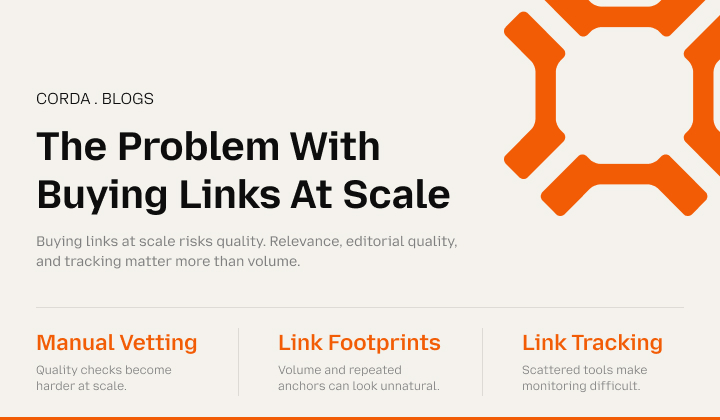
The actual problem is that you will find it really hard to manage all the purchased links manually. Especially if you are doing that through one spreadsheet only.
Having said that, what are the main issues you will be facimg? And remember these issues are unavoidable.
To clarify, you won’t be able to manually check the domains for all 40 placements. Expeciially when your team is small. As a result, you do not have complete control and confidence in the backlink profile you have built.
Now you understand the problemof buying links at scale. But that’s not what the article is about.
We will shed light on how Corda can help you solve the problem easily and without any manual interference. That too with the assurance of building a very strong backlink profile. Want to know how? Keep reading!
Why Are So Many Brands Still Buying Links?
A good placement is still the most effective way to draw authority or traffic to your site or page. A page that is already ranking willcertainly make the link juice flow to your page or link. There is no doubt about that.
Let’s check out what Sales Hive’s guide says. If you are buying placements in a page at #1 position, then the backlinking credibility becomes 3.8X compared to the pages ranking on the 2nd page.
The same research also states that 95% of pages do not have any backlink. Therefore, only a ew good backlinks can divert credible traffic to your page. In reality, you need only a good backlink from a site that has high DA and DR (for ex DA more than 70).
But that’s not the only parameter you must check out. The content where you are inserting your link must be relevant to your business niche. Or the content at least. At least you have to make a niche edit to make it relevant. The SalesHive’s guide also informs that
Because links still move the needle, or at least people believe they do. And the pages that rank well make a compelling case. SEO leads close at 14.6%, compared to 1.7% for outbound leads.
Meanwhile, the traffic redirected through organic search for the page linked, can also be a source of substantial B2B revenue. That’s the reason in-house teams or SEO agencies are so eager to buy links at scale.
Why Do We Percieve Link Buying In Negative Light?
Nobody can settle for the fact that buying links is wrong. But there are a lot of clauses that come with it. Most importantly bought links will work only on the condition that all the links are manually vetted and are from relevant business sites.
In fact, there should be a pattern to the links also. But ensuring that every time you are buying 40 links to scale your business fast, is almost impossible.
Is Buying Links Even Allowed?
This is where people get confused, so let me keep it simple.
Buying a link isn’t illegal. SalesHive says the same: nobody goes to jail for it. But legal and Google-compliant are two different things.
According to Google’s spam policies, exchanging money, goods, or services for links that pass ranking credit counts as link spam.
Linkdoctor’s Guide Breaks It Down Well:
As LinkDoctor notes, the problem isn’t that money is ever involved in online promotion. The problem is paying for links specifically to manipulate rankings. Google recommends marking paid placements with rel=’sponsored’, and rel=’nofollow’ is also accepted.
Now compare that with LinkLifting’s closing advice, which is basically to buy links and make them look organic to Google. Read that twice.
You can easily understand that the whole strategy rests on disguising intent. So until you are buying 4 to 5 links, that is alright. Most importantly you can manually scrutinize and manage a few links.
But what if you are buying 500 links. Surely search algorithms will catch that pattern and penalize you. That’s another risk of buying links at scale.
What Do The Pro-Buying Guides Get Right?
According to SalesHive, if you are buying links then select domains which are the same as the one your business or the clients’ links belong to. That’s how you can draw 2.7X more traction. In fact, the guide also clarifies that around 58% SEO professionals also align with this idea.
Another source argues that you should place your link on a site that has genuine traffic. That’s way more effective compared to a site that’s highly relevant but has 0 or almost no organic traffic.
In connection, SalesHive also argues that if you are buying links, it is better to purchase niches inside the article’s main body rather than in sidebars or the page footer. Corda can select publishers from step 1 based on such nuanced preferences.
The next most important thing that a lot of SEO professionals miss is that you need to mix the type of links you are buying. However it is practically impossible to keep track of the links you are buying if you are buying at scale.
That’s where you need Corda. You get that mix and match done without your input or prompting. What kind of mix can you expect when you are on Corda?
The best mix is of guest posts, digital PR, and lots of branded niche based content, alongside others. Corda’s AI module is trained to seamlessly do that for every workspace.
So Why Does Buying Links Fall Apart At Scale?
Let me walk through the cracks one by one.
1. Manual Selection Doesn’t Scale
LinkDoctor lists what a proper check involves: topical relevance, organic traffic and its trend, what the traffic is actually about, editorial quality, outbound links, indexation, placement, and anchor text.
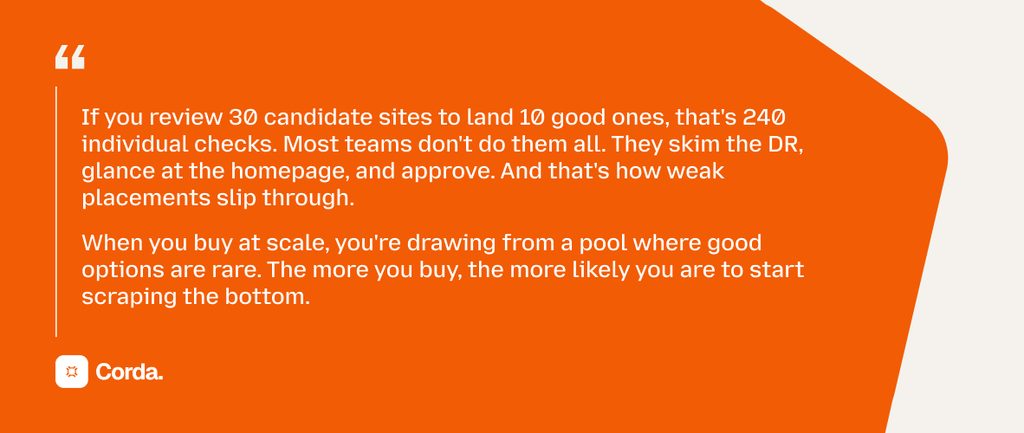
That’s eight checks per site. Now multiply it.
2. The Same Sites Keep Showing Up
One of LinkDoctor’s red flags is a domain that appears in every vendor’s database.
When several vendors sell the same sites, you can end up with the same publishers across different campaigns, or even across competitors. That doesn’t look like earned editorial attention. It looks like an inventory list.
3. Good Inventory Is Thinner Than It Looks
LinkDoctor cites BuzzStream’s 2026 analysis of nearly 500,000 guest-post sites. The average vendor price for a guest post was about $461, and buying directly from a site averaged around $295.
But only a very small share of the inventory was classed as high-quality or top-tier. Link insertions averaged about $179, and the overwhelming majority of sites selling them fell into the lower-quality group.
So when you buy at scale, you’re drawing from a pool where good options are rare. The more you buy, the more likely you are to start scraping the bottom.
4. Prices Tell You Almost Nothing
Here’s a funny thing. SalesHive’s own guide gives two different cost ranges. One section says quality links typically run $50 to $500 each. Later, it says quality links run $700 to $2,000 or more. Even the guides that promote buying can’t agree on what a link costs.
LinkDoctor’s point is the most useful one: price tells you very little about whether a backlink is good. You can pay $1,000 for a poor one. At scale, that mistake isn’t made once. It’s made over and over.
5. Scale Creates Footprints
This one comes straight from LinkLifting. Its guide says Google wants a natural-looking link profile. A site that averages 5 backlinks a month and suddenly gets 750 doesn’t look natural. And pointing 50 links at one page in a month without touching any other page signals that links are being paid for.
Think about what that means. The same guide that tells you to buy links also admits that volume, speed, and repetition give you away. Scale is literally the thing that makes a profile look purchased.
The same goes for anchors. LinkDoctor warns that forcing the same exact-match keyword again and again makes a profile look unnatural. When 40 placements are ordered from a spreadsheet, repeating anchors is almost the default.
6. Predictable Delivery Isn’t Predictable Results
LinkDoctor puts it perfectly. A seller promising 10 links for a fixed price feels predictable. But a provider can guarantee your URL appears on a page. They cannot guarantee how Google values that link or where your page ranks afterward.
7. Links Decay
A site that looks fine today can lose traffic, change owners, start selling links aggressively, change its niche, remove your content, or disappear. LinkDoctor lists all of these. At low volume, you notice. At high volume, you only find out when rankings dip, and by then you can’t tell which of your 200 links is the culprit.
8. Nobody Can See The Whole Picture
This is the operational problem. Orders sit in one tool, budgets in another, live URLs in a spreadsheet, and metrics in a third dashboard. Ask who approved a specific placement, what it cost, and whether it’s still live, and you’ll get three different answers.
A Quick Look: What The Guides Say VS. What Happens At Scale
| What the guides advise | What happens when you buy 50+ links |
| Check relevance and traffic for every site | Teams skim DR and approve in bulk |
| Choose editorial, in-content placements | Cheaper packages push footers, bios, and forced paragraphs |
| Keep a natural link profile | Volume spikes and repeated anchors create a footprint |
| Vet the vendor | Several vendors resell the same domains |
| Pay for quality | Pricing is inconsistent, and price doesn’t prove quality |
| Monitor your links | Nobody tracks which placements are still live |
Where Do The Real Risks Show Up?
Let me be fair here. Not every bad link ends in a dramatic Google penalty. LinkDoctor says the more common outcome is simpler: you waste your money. Google may ignore the link, it may send no referral traffic, and the site behind it may lose its value later.
That said, bigger consequences exist. Google can take manual action when reviewers decide a site violates its spam policies, and you can check this in Google Search Console under Manual Actions. SalesHive goes further.
It says Google’s SpamBrain system devalues manipulative links within minutes, that toxic links affect about 23% of websites, and that spam scores correlate with roughly a 15% drop in organic visibility when ignored.
A fair word of caution. Those are SalesHive’s own figures, and the guide doesn’t give a clear source for every one of them. Treat them as directional, not as gospel. The point still stands: the cost of cleanup, such as audits and disavow files, grows with the number of questionable links you’ve collected.
So at scale, you face two kinds of loss. A quiet one, where money goes into links that do nothing. And a loud one, where a pattern catches attention. Neither is cheap.
Clickbait VS. Real Benefits: How To Spot The Difference
Okay, enough doom. Let’s talk about how to tell a genuine offer from a flashy one, because this is where most people lose money.
| The clickbait | The real benefit |
| ‘100 DR 50+ backlinks for $299’ | Fewer placements, each one visible and checked before you pay |
| ‘Guaranteed first page ranking’ | A clear plan based on your actual authority gaps |
| A hidden domain list until after payment | Publisher metrics you can review first |
| ‘Instant results’ | A realistic timeline and ongoing tracking |
| ‘We pick everything for you’ | Recommendations that you can approve, change, or reject |
| One big number, usually DR | Relevance, traffic, editorial quality, and context together |
LinkDoctor has the same warnings in its own list: avoid cheap bulk packages, hidden domain lists, DR-only decisions, high-authority irrelevant sites, forced anchors, and ranking guarantees.
Notice the pattern. Clickbait sells you a number. Real benefit gives you a decision you can understand.
How Can Corda Help You Buy Links Without Losing Control?
Here’s where Corda comes in.
Corda is an AI-powered authority and campaign management platform. In plain words, it helps you understand where your website is falling behind, find the publishers worth pursuing, and turn that into an organized campaign.
The idea behind it is simple. Ranking problems aren’t always solved by simply getting more backlinks. First you need to know what’s actually holding you back.
Every problem we covered above has a matching piece in the workflow.
Problem: You Don’t Know What You Actually Need.
At first Corda will anayze your niche and the current status of your website. After that Corda will presenta detailed competitoor gap and competitor analysis. Check whether competitors are targeting publishers who have not been in your radar.
The next step with Corda is finding out the authority gaps that you must target, based on a priority order. As a result, you will find yourself not buying links at scale. But fovcusing on the gaps that matter and buying links on a qualitative basis.
Problem: Manual Selection Is Too Slow.
That’s why Corda is there. You get a manual and an AI powered publisher discovery stage. Here you can choose wjhch mode you want to go with. Here you can filter publishers based on DA/DR and recurring stable traffic for each site where you will publish your llinks.
Most importantly. Corda gives an AI match score for every publisher based on its authority profile and your niche requirements. All of that can happe within minutes with Corda.
Problem: Nobody Can See The Whole Picture.
Campaign planning and tracking sit in one place. You choose placements, set objectives and budgets, manage approvals, and follow placement status. A wallet and budget ledger shows spending and payment activity, and tracking covers authority signals and changes in search and AI visibility.
The platform is organized around three areas that work together:
- Corda Opportunities: compare your site with competitors and find gaps worth pursuing.
- Corda Marketplace: browse and compare publishers by relevance, quality, industry, region, traffic, authority metrics, and budget.
- Corda Campaigns: turn the selected opportunities into organized campaigns and track order statuses.
You can read more in the Corda product overview and the About Corda page.
Is There An Easy Way To Start?
Yes, and that’s the whole point. Here’s a scenario.
An agency manages 12 clients. Each needs a handful of placements this quarter. In the old way, someone builds a spreadsheet, pulls prospect lists from three vendors, checks sites one by one, argues over price, and then forgets to track whether links stay live.
With a connected workflow, it looks more like this:
Step one: Analyze the client’s website and compare it with competitors.
Step two: Look at the authority gaps and decide which ones deserve a budget first.
Step three: Review recommended publishers, compare their metrics and relevance, and pick the ones that fit.
Step four: Build the campaign, set the budget, and manage approvals and placements.
Step five: Track status, spending, and authority and visibility signals, then use what you learn to plan the next round.
No magic. Just fewer places for things to go wrong.
And here’s the part that matters for different teams. Brands, such as founders, small businesses, and lean marketing teams, get a clearer path without building a large SEO team or relying entirely on expensive agencies.
Agencies get less manual research, more structured campaign management, and the ability to scale client delivery without building every process from scratch.
What Corda Won’t Do (And Why That’s A Good Thing)
Now let me be careful here, because this whole article is about honesty.
Corda helps businesses plan and manage the work that supports digital authority. It does not guarantee search rankings, AI citations, traffic growth, leads, or sales. Nobody can promise that, and you should walk away from anyone who does.
AI also plays a supporting role. It helps analyze, prioritize, and recommend. You keep control over publisher selection, campaign priorities, and budgets. And since features and data sources may vary by product version, check what’s currently available before you plan around any specific one.
That’s the honest promise: better-informed decisions and more organized execution, with the aim of improving visibility over time.
So, Should You Stop Buying Links?
Not necessarily. The pro-buying guides are right that links matter, and the cautious guides are right that not every paid link is the same.
LinkDoctor makes a distinction worth remembering: paying for research, outreach, content, and campaign work is different from simply paying a publisher for a following backlink.
The real problem isn’t buying. It’s buying blindly, in bulk, with no way to see the pattern you’re creating.
So before your next order, ask yourself three questions. Do I know which authority gaps I’m trying to close? Can I see every site before I pay? And could I explain, a year from now, why each link is there?
If any answer is no, it’s time to fix the process before you spend more. Take a look at Corda, see how the workflow connects analysis to action, and build your next campaign around clarity instead of volume.