

Honestly speaking, any good SEO person would give you the same answer. How should you judge backlinks? By the number of links or their quality.
Almost 99.999999% of answers will say “by link quality.” So why are we debating link quality versus the number of links in this article?
That’s easy. Still, many people think the lag in link quality can be offset by the number of backlinks. And that’s where the SEO teams fail!
Imagine you invested in building 50 links a month, which comes down to 150 per quarter. To present it to your manager, it’s surely a good stat.
But can this bulk of backlinks actually move rankings or increase your revenue?
Honestly, link count can’t guarantee that.
A higher link count only shows you’ve put in great work. However, quality link building ensures you are building authority, and that is what matters the most when you are building links.
But if a non-believer asks, why do you focus so much on link-building quality? After all, the link juice from 1 link is the same. How much of a difference does a quality link make?
So, Does A Quality Link Actually Deliver Something Extra?
That is one of the major queries. We’re going to answer it once and for all.
Only quality links will help you overcome the challenges of algorithm updates. Otherwise, Google won’t give traction to links placed in content just for link-building’s sake.
Again, if you want your niche link to appear in competitive search results, quality link building is the only solution.
Now, if you are wondering how we will meet the link-building count while still ensuring link quality, Corda has the answer.
Link Quantity: Where It Helps And Where It Makes No Sense
Link quantity is just a headcount. How many backlinks, or referring domains, point to your site? That’s it. It’s easy to track, report, and sell to a client. Which is exactly why people love it.
And look, quantity isn’t useless. A site with zero links will struggle no matter how brilliant the content is. A healthy profile needs steady growth too. No argument there.
The trouble starts when volume becomes the goal instead of a by-product. Teams begin chasing numbers, and the chase leads straight to directories, link farms, thin guest posts, and sites that exist only to sell placements.
Is it Cheap? Yes. But how fast is it? Absolute.
And what about relevance? Hardly relevant ever.
A pile of these can even look unnatural to search engines, and instead of helping, they dilute your profile or invite scrutiny you never wanted.
There’s a quieter problem too: wasted effort. Every low-value link eats outreach time, content, and budget. All of that could have gone into one placement that actually moves the needle.
Link Quality: How Do You Define It?
Link quality is about how much trust and relevance a link passes to your site. No single metric captures it. That’s why relying on a single score, like Domain Authority or Domain Rating, is risky.
You need to look at several signals together:
Topical Relevance
A link from a site your audience actually reads in your niche tells search engines far more than a link from an unrelated site with a higher score.
Real Organic Traffic
A site with genuine visitors and rankings is a living publication. A high score with no traffic? Red flag.
Editorial standards
Good publishers review what they publish. A link inside useful, original content carries more weight than one dropped into filler.
Placement and context
A contextual link in the body of a relevant article beats a footer or sidebar link every time.
Link neighborhood
Who else does this site link to? If it’s surrounded by spam or obvious paid links, it can drag your profile down.
Natural anchors and velocity
Good links show up at a believable pace, with varied anchor text that reads naturally.
Here’s a better way to think about it. Quality link building is a filtering problem. The question isn’t “how many sites can we reach?”
It’s “which sites are worth reaching, and why?” Answering that properly takes data. A lot of it.
Quantity VS. Quality At A Glance
| Link quantity | Link quality | |
| What it measures | Number of links or referring domains | Trust, relevance, and impact of each link |
| Typical sources | Directories, thin guest posts, bulk placements | Relevant, editorially reviewed publications |
| Speed | Fast and cheap | Slower to find, far more durable |
| Risk | Dilutes the profile, can look unnatural | Low when vetting is consistent |
| Ranking impact | Unpredictable | Strong and compounding |
Why “Quality VS. Quantity” Is Not Actually What You Should Compare
Most articles on this topic end with “choose quality.” Fair enough. But that’s only half the story.
In competitive niches, a handful of great links rarely does the job alone. Lasting rankings come from earning a steady flow of relevant, authoritative links over months and years. So volume matters too, as long as every single link in that volume clears a quality bar.
The real question, then, is how to scale quality. And that’s hard. Quality placements are scarce. Finding them is slow. Vetting each one takes real expertise.
Then you have to juggle outreach, content, payments, and reporting across dozens of publishers, which is a massive operational headache. Most teams can’t keep that up by hand, so they slide back to the easy, low-quality options.
That scaling problem is exactly why we built Corda. Quality link building at scale isn’t only a staffing challenge anymore. It’s a data and technology challenge.
Inside Corda: The Technology Behind Smarter Authority Building
Corda is an AI-powered authority intelligence platform. Not a directory of sites. Not a marketplace with a search bar. Think of it as an intelligence layer that connects three sets of data: your brand, your competitors, and the publishers available to you. From that connected view, the platform runs a repeatable workflow:
- Authority analysis: checking where your brand stands today.
- Competitor gap discovery: finding where rivals earn authority that you don’t.
- Publisher matching: pairing your brand with relevant publishers.
- Campaign recommendations: suggesting which placements to go after.
- Execution: handling outreach, content, and placement.
- Performance feedback: sending results back in so the next round of decisions gets better.
That last step is actually very critical. Because performance data flows back into the system, the platform learns which placements really produce results instead of repeating the same old assumptions.
Why does AI matter here? One campaign can involve thousands of candidate publishers, each with dozens of data points. No human team can weigh all of that consistently.
So machine learning does the repetitive scoring and pattern-spotting, while people stay in charge of the judgment calls: relationships, editorial fit, and brand safety. The idea isn’t to replace expertise. It’s to point it at the right opportunities.
And this didn’t come out of nowhere. Our models and workflows were shaped by years of hands-on work, real campaigns, real publisher responses, and real ranking outcomes.
How Corda Does Competitor Analysis
Competitor analysis is where most quality link building decisions are won or lost. It’s also where the manual work gets heaviest. The old way? Pull a competitor’s backlink profile from a tool, export it, filter out the noise, and go through thousands of rows by hand. Nobody enjoys that!
Corda automates it and makes it sharper:
- It maps competitor authority. The platform looks at the publishers and pages linking to competing brands, so you can see which sources shape their visibility.
- It identifies the gaps. It highlights sites that link to your competitors but not to you. These are proven opportunities, because the publisher has already shown it’s willing to cover your space.
- It filters for quality. You don’t get a raw list. We score opportunities on relevance and authority, so low-value sources drop out early.
- It matches gaps to real publishers. Findings connect to publishers we can actually work with. That closes the distance between insight and execution.
- It recommends campaigns. The output isn’t a spreadsheet. It’s a set of suggested actions you can approve and track.
So the analysis moves from “here’s what they have” to “here’s what to do about it.”
The Technical Integrations Behind The Platform
A platform is only as useful as the data and tools it feeds on. That’s why Corda is built around API integrations with the tools SEO teams already use, so the work happens in one place:
- Ahrefs, Semrush, and Moz supply backlink, traffic, and authority data for evaluating publishers and analyzing competitors.
- OpenAI and Claude power content and analysis workflows, like drafting, summarizing, and judging publisher fit.
- Ollama lets us run language models locally, which gives us more flexibility and control over certain AI tasks.
- Grammarly keeps written content clean and polished.
- Copyscape checks content for originality before anything goes live.
- AWS and Cloudflare provide the cloud infrastructure, speed, and security that keep the platform reliable.
The practical payoff? Quality control is baked into the workflow. Content gets checked for originality and grammar.
Publishers are vetted against several data sources, not a single score. AI help is available inside the platform, not in yet another subscription tab. It’s quality link building with the guardrails already in place.
Ten Years Of Experience Behind Every Placement
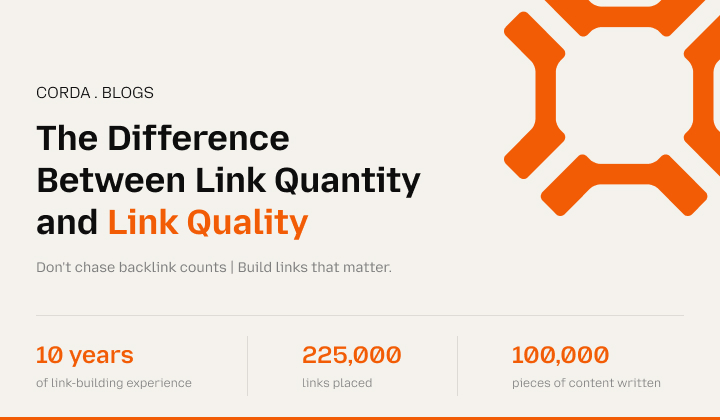
Technology matters. But so does track record. Corda comes from a team with ten years of industry experience building authority through link placements. In that time, we have:
- Placed 225,000 links, using machine learning and artificial intelligence to guide the work
- Written 100,000 pieces of content to support those placements
- Delivered numerous niche edits for link insertions
- Worked with more than 120,000 publishers
That history gives us something rare: a deep view of what publishers respond to, which placements age well, and which patterns signal trouble. Our approach has always been grounded in that evidence. Corda packages it into software, so you get a decade of lessons without repeating the expensive mistakes.
What Exclusive Does Corda Bring To The Table For Users?
Quality link building isn’t just a strategy question. It’s a cost and operations question too. Here’s where the platform changes the math.
Fewer Hours Spent Finding Sites
Prospecting is one of the biggest time sinks in link building. Corda surfaces relevant publishers and matches them to your brand, so your team spends far less time searching, filtering, and vetting.
Lower Tool Costs
Agencies and brands often pay separately for backlink tools, plagiarism checkers, grammar tools, and AI subscriptions. Corda has already integrated Ahrefs, Semrush, Moz, Copyscape, Grammarly, OpenAI, Claude, and more through API.
So you skip paying for those layers yourself, along with the extra AI subscription charges that keep piling up.
Smaller Teams, Smaller Payroll
Prospecting, vetting, content, and reporting normally need several specialists. Corda cuts the manpower an SEO agency needs, and the salary overhead with it.
One Payment Instead Of Multiple
Paying publishers and freelancers one by one means transfer fees, PayPal charges, and currency conversion costs on every transaction. On Corda, you make a single monthly payment.
One dashboard To Replace Fifty spreadsheets
You get prospect lists, outreach status, content, links, and reporting live in one place. Nothing gets lost across tabs and version histories.
Complete Visibility
You can see exactly what your SEO and link building team or vendor is doing, which placements are in progress, and what has gone live.
For agencies, that means cleaner client reporting. For brands, it means real accountability.
Exclusive Perks: Fresh Sites And Active Outreach
Access is the other half of quality link building. The best publishers don’t stand still, and the most valuable placements are often on sites that haven’t been over-pitched yet.
Access to the freshest high-authority websites: Corda members get newly identified, high-authority sites before they get flooded with pitches.
Constant outreach: Our outreach team contacts 1,500 to 2,000 new sites and bloggers every month. That keeps the publisher network growing and the opportunities current.
As the network refreshes, you’re not fishing in the same overused pond as everyone else.
Proven With Some Of The Biggest Brands
We work with major brands and have driven results for names like CapCut, Fortinet, TradingView, Sangfor, Goodr, Pirate Bay, and ByteDance.
These are competitive, high-scrutiny categories. And they’re exactly where the gap between link quantity and link quality shows up in real results.
A Practical Checklist For Quality Link Building
Whether you use Corda or not, here’s a simple checklist you can run on any link opportunity:
- Is the site relevant to your niche and audience?
- Does it have real, consistent organic traffic?
- Is the content original and editorially reviewed?
- Is the link placed contextually within useful content?
- Does the site link out to reputable sources, or is it surrounded by spam?
- Would the link still make sense if search engines didn’t exist?
- Does it fit a natural growth pattern for your profile?
If a link fails more than one or two of these, skip it. Fewer links that pass the test beat a long list that doesn’t.
Higher Earnings Against Lesser Hassles
So what’s the difference between link quantity and link quality? Quantity counts links. Quality earns trust. Search engines, publishers, and readers all reward the second one.
Quality link building needs relevance, careful vetting, and consistency. Doing all three at scale used to mean big teams, loads of tool subscriptions, and a mountain of spreadsheets.
Corda changes that. You get AI-driven competitor analysis, a full stack of integrated tools, ten years of experience, 225,000 links placed, and a network of more than 120,000 publishers. Find better opportunities faster, spend less time on it, and see everything in one dashboard.
If you’re ready to stop chasing link counts and start building lasting authority, get in touch with the Corda team and see the platform in action.