

SEO link building used to involve a relatively simple process.
- Find websites.
- Check their metrics.
- Contact them.
- Get links.
That process still exists. But the amount of information available to SEO teams has changed the job.
Today, you can pull backlink data from multiple tools, compare competitors, examine referring domains, inspect anchor text, track rankings, monitor traffic, evaluate publisher metrics, and analyze thousands of potential prospects.
The problem is no longer a lack of data. It is knowing which data deserves attention.
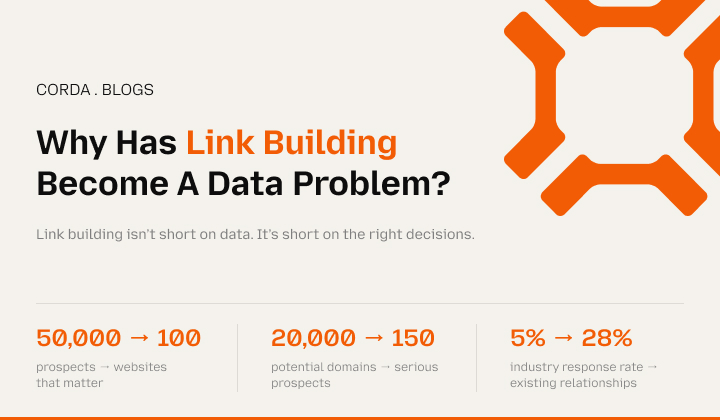
A link-building team can have 50,000 prospects and still struggle to identify the 100 websites that matter.
That is why modern SEO link building is increasingly becoming a data problem.
More Backlink Data Does Not Automatically Mean Better Decisions:
SEO platforms can tell you an enormous amount about a website. You can see:
- referring domains
- backlinks
- anchor text
- estimated traffic
- authority metrics
- linking pages
- historical changes
- competitor overlaps
- broken backlinks
- new and lost links
- top linked pages
All of this sounds useful. And it is. But raw data does not tell you what to do with it. Now, consider a list of 5,000 websites that link to your competitors.
The list itself is not a strategy. Why? Because it’s just a list.
You still need to determine which websites are genuinely relevant, publishers have real audiences, links are editorial, domains are worth building relationships with, and competitors earned the link for a specific reason.
Also, you need to find out which pages on your website deserve links and which prospects are realistic.
Most importantly, find out which opportunities could strengthen your broader authority. That layer of interpretation is where much of the real work happens.
The Old Link-Building Workflow Was Built Around Volume:
For years, many link-building campaigns were organized around simple output metrics.
A campaign might have a target such as: 100 backlinks per month. Then, the team worked backward from that number.
More prospects meant more outreach. More outreach meant more responses. And more responses meant more placements.
Also, more placements meant more links.
The model was easy to measure. Moreover, it was also easy to optimize for the wrong thing.
As a result, if the objective becomes “get 100 links,” the campaign can gradually favor websites that make those 100 links easiest to obtain.
That can push relevance, editorial quality, and strategic value into the background. Data can make this problem worse when teams optimize around whatever is easiest to count.
A Link Is Not Just A Link:
Two backlinks can look similar inside an SEO platform and have completely different strategic value.
So, let’s imagine these two links:
Link A: A contextual mention from a respected industry publication in an article closely related to your product.
Link B: A link from a generic website with thousands of unrelated commercial pages.
Both may appear as backlinks in your report. Now, they are not equivalent opportunities. Rather, the difference comes from context.
In this case, you need to understand:
- who links to you
- where the link appears
- why the page links to you
- whether the publisher is relevant
- what the surrounding content discusses
- whether the page attracts an audience
- whether the link is editorial
- what role the linked page plays
This is why backlink databases are starting points rather than final answers.
Relevance Has Become Harder To Measure:
One of the biggest data problems in SEO link building is relevance. Authority metrics are relatively easy to compare.
But relevance is not.
As a result, understand that a tool can assign a score to a domain. But deciding whether that domain is genuinely relevant to your business often requires context.
Now, consider a company selling accounting software. A link from a finance publication is obviously relevant.
But what about:
- a startup publication?
- a small-business blog?
- an entrepreneurship newsletter?
- a university business resource?
- a local business organization?
So, the answer depends on the page, audience, topic, and reason for the link. A website does not need to be exclusively about your industry to be relevant.
Sometimes the most useful links come from adjacent topics. That makes relevance difficult to reduce to a single metric.
Authority Metrics Can Hide The Real Opportunity:
SEO teams often use third-party authority metrics to sort prospects. And that is understandable.
You need some way to manage a large dataset.
But metrics such as Domain Rating, Domain Authority, or similar scores are measurements created by SEO platforms. They are not direct measurements of how much value a search engine assigns to a website.
They can be useful for comparison. Also, they become less useful when they replace judgment.
For example, a smaller specialist publication may have a modest authority score but an audience directly aligned with your business.
A large general-interest website may have a much higher score but little topical connection. So, if you only sort the database by authority, you can easily prioritize the wrong websites.
The data is not necessarily bad. The interpretation is.
Competitor Backlinks Create Another Data Problem:
Competitor backlink analysis is one of the most useful ways to discover link opportunities. Also, it is easy to misuse.
So, suppose three competitors have links from the same publication. That looks promising. But why did they receive those links?
Maybe the publication reviewed their products. Maybe one competitor supplied original research. And maybe another founder was interviewed.
The backlink database can show you that the link exists. It usually cannot explain the complete business relationship behind it.
You need to inspect the actual linking page. This is why competitor backlink data should be treated as evidence, not instructions.
The Data Is Distributed Across Too Many Places:
Another problem is fragmentation.
A typical SEO team may use one platform for backlink data, another for keyword research, another for traffic estimates, Google Search Console for search performance, Google Analytics for website behavior, and spreadsheets for outreach.
Each system contains part of the picture. The link-building decision sits somewhere in the middle.
So, imagine evaluating a potential publisher.
You might need to combine:
- Backlink data: Does the website link to relevant companies?
- Search data: Does it appear to attract search visibility?
- Content data: Does it publish genuinely useful material?
- Competitive data: Do comparable businesses have relationships with it?
- Business data: Does its audience match your target market?
- Outreach data: Have you contacted it before?
- Campaign data: Did previous placements from similar publishers produce useful results?
No single metric answers the question. The decision requires joining the data.
Link Building Needs A Better Unit Of Analysis:
The backlink itself is often treated as the basic unit of SEO link building. That is increasingly limiting.
A better unit is the relationship between the website, publisher, page, topic, and reason for the link.
Now, consider a publisher that links to your website five times. In that case, you could report: ‘Five backlinks acquired.’
Or you could understand: One relevant publisher has repeatedly referenced our research because we consistently produce useful industry data.
The second interpretation tells you much more. It explains what generated the links. Also, it suggests what you should do next.
This is the difference between reporting links and learning from them.
Historical Link Data Can Tell You What Actually Works:
A mature link-building operation should eventually build its own historical dataset. Instead of asking only, ‘How many links did we build?’ ask:
- Which publisher types responded most often?
- Which topics attracted the most links?
- Or even which content formats earned citations?
Additionally, you can also ask which outreach angles generated replies or which placements were indexed.
More importantly, consider asking which links remained live and which publishers repeatedly linked to us.
This changes link building from a recurring acquisition task into a learning system. Your previous campaigns become evidence for future decisions.
Your Own Data Is Often More Useful Than Industry Benchmarks:
Industry benchmarks can be useful for context. But your own campaign history can tell you something more specific.
So, suppose an industry report says editorial outreach has a 5% response rate. That number may tell you very little about your campaign.
Your own data might show that:
- research-led pitches receive 11% replies
- generic guest-post pitches receive 3%
- existing relationships produce 28%
- highly relevant publishers convert at twice the rate of broad prospects
Now you have information that can change your process. The goal is not to collect impressive statistics. It is to identify patterns that improve decisions.
Link Prospecting Is Becoming A Filtering Problem:
The scale of available data changes how teams should think about prospecting. The question is no longer ‘How can we find more websites?’
Instead, it is ‘How can we remove the wrong websites faster?’
Now, imagine starting with 20,000 potential domains. Your first filter might remove irrelevant industries.
The next might remove sites with no meaningful audience. Another might remove obvious low-quality or inactive properties.
Then you examine topical relevance before moving on to competitor relationships and editorial fit. Then the specific pages where your brand could contribute something useful.
By the end, you may have only 150 serious prospects. That is not a failure of the process. TBH, it is the point.
A good data workflow reduces noise before a human spends time on outreach.
Automation Helps, But It Does Not Replace Judgment:
Automation can make link-building research dramatically faster. TBH, it can help collect:
- competitor backlinks
- referring domains
- authority metrics
- traffic estimates
- anchor text
- contact information
- historical links
- content categories
Also, it can identify patterns across thousands of records. But automation struggles with questions such as:
- “Would this publisher genuinely want this information?”
- “Is this website respected by the audience we care about?”
- “Why did this competitor receive this mention?”
- “Would our brand make sense in this article?”
Those questions require context.
The most effective workflow is therefore not data versus humans. It is data before human judgment.
Let machines narrow the dataset. Let people decide what deserves attention.
Data Can Also Expose Weak Link-Building Strategies:
Better analysis does not always produce more prospects. Sometimes it exposes that your existing strategy is too dependent on one type of link.
For example, your backlink profile might show heavy dependence on:
- guest contributions
- directories
- partner websites
- one publisher category
- branded anchors
- a small group of domains
That does not automatically mean those links are harmful.
But it can reveal concentration.
A more resilient strategy may need a broader mix of genuine editorial references, industry resources, original research, partnerships, digital PR, and useful content assets.
The data helps you see the shape of your strategy.
The Best Link-Building Data Often Starts With A Business Question:
This may be the most important shift.
Do not start with: “What backlink data can we export?”
Start with: “What are we trying to understand?”
For example:
- Question: Why are competitors earning links from publishers we cannot reach?
- Data: Competitor referring domains and linking pages.
- Question: Which types of content attract the most external references?
- Data: Linked pages, topics, formats, and historical acquisition.
- Question: Are we building relationships with the right publishers?
- Data: Publisher relevance, repeat placements, referral traffic, and campaign history.
- Question: Where are we underrepresented compared with competitors?
- Data: Referring-domain overlap and content-level link gaps.
The question determines the data you need. Without the question, data collection quickly becomes another form of busywork.
What Good Link-Building Analysis Looks Like:
Good analysis does not produce the longest prospect list. It produces better questions.
You might discover that competitors consistently earn links from specialist publications because they publish original research.
You might find that your own strongest links come from data-driven content.
Also, you might learn that certain publishers repeatedly respond to expert commentary but ignore generic outreach.
Each finding changes what you do next. And that is honestly the real value of data. Not more rows. Better decisions.
SEO link building has become a data problem because the industry now has more information than most teams can meaningfully interpret.
Backlink databases are enormous. Competitor research is deeper. Publisher metrics are everywhere. Automated prospecting can generate thousands of opportunities in minutes.
But none of that answers the central question: Which links are actually worth pursuing for this website?
The answer requires more than a domain score.
It requires context, relevance, competitive intelligence, content analysis, relationship history, and evidence from previous campaigns.
The future of link building is therefore unlikely to belong to the team with the biggest prospect database.
It will belong to the team that can turn a large amount of messy data into a small number of well-supported decisions.
That is what makes data useful in SEO link building.
Read Also: