

With Google Updates changing the rules every few months, writing a piece of blog and hoping it dominates SERPs isn’t going to cut it in 2026.
Rather, it’s your backlink analysis and link-building strategy that truly counts. And while backlinks are an easy SEO metric to count and consider, most SEO professionals end up looking at backlinks as a quantity game.
For instance, if website A has 3,000 referring domains and website B has 500, then most people will say that website A has more authority in comparison to website B.
But backlink counts can be misleading.
A link from a highly relevant industry publication may tell search engines more about a website than dozens of unrelated links.
Also, a website can easily acquire hundreds of backlinks without building any trust, visibility, or even basic relevance.
And that is precisely why no backlink analysis strategy should start with how many backlinks a particular website has.
Rather, you should look at the quality of backlinks you have and find out what these links actually say about your site.
More backlinks simply doesn’t mean more authority – and this is where analyzing your backlinks becomes super important.
On that note, this blog will break down backlink analysis in detail and highlight why more backlinks don’t always mean more authority or trust.
Stay tuned.
Backlinks Are Signals, Not Authority Points:
A backlink is essentially an external reference to your website. Having said that, not every reference requires the same type of context.
So, let’s assume that two websites are competing for the same topic. Now, while one site has 2,500 backlinks, the other site has only 200 backlinks.
Of course, it might feel like that the site with 2,500 backlinks has more authority. This is where backlink analysis becomes essential.
Once you analyze the quality of backlinks, you find out that the site with 2,500 backlinks has links from unrelated blogs, generic websites, directories, and pages that act as link farms.
In contrast, the site with 200 referring domains includes respected publications, specialist websites, industry resources, and websites that naturally discuss its work.
The numbers alone make Site A look stronger. The context may tell a very different story.
Search engines have become much better at evaluating links in relation to the pages, topics, and websites surrounding them.
So backlink quantity should be treated as one piece of evidence, not a direct measurement of authority.
A Backlink Has Context:
Consider a company that sells accounting software.
A backlink from an established accounting publication makes intuitive sense. Also, a link from a software review website may make sense as well.
Now imagine that the same company suddenly receives hundreds of links from websites about travel, fashion, gaming, and cryptocurrency.
The links exist.
However, what do these links tell Google or other search engines about the company? Hardly anything.
This is why relevance matters.
A backlink is not valuable simply because another domain links to you. Its surrounding context can determine how useful that link is as evidence about your website.
Referring Domains Matter More Than Raw Backlink Counts:
TBH, this is yet another common source of confusion.
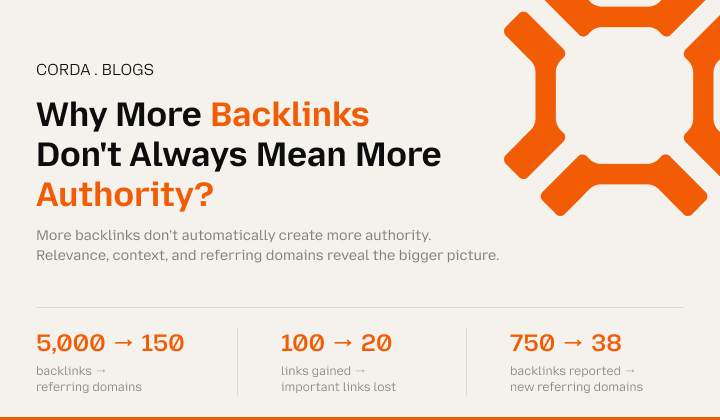
So, a website can have 5,000 backlinks but only 150 referring domains. Now, you might wonder how – basically, this happens when the same websites keep linking to a site repeatedly.
For example, a sitewide footer link could appear across thousands of pages. The backlink counter sees thousands of links, while the referring-domain count sees one linking website.
These numbers answer different questions.
As a result, while backlinks will tell you how many links point to your website, referring domains point out how many websites link to it.
Frankly, neither metric is able to tell the whole story.
But looking only at total backlinks can dramatically exaggerate how broad a site’s external support actually is.
One Strong Link Can Be More Informative Than 100 Weak Ones:
This is where backlink analysis becomes more interesting.
So, suppose a cybersecurity company publishes original research on phishing attacks. An established security publication references that research in an article.
That link has context.
The publication is relevant to the subject. The page discusses the research. And readers could reasonably follow the link to investigate the source.
Now compare that with 100 links from websites that have little connection to cybersecurity. The second group is larger, and the first may be more meaningful.
This doesn’t mean one strong backlink automatically outweighs 100 other links in every ranking situation.
There is no universal conversion rate where one high-quality link equals a fixed number of lower-quality links.
The point is simpler: Links should be evaluated for what they represent, not just how many exist.
Relevance Is More Than Matching Keywords:
People often reduce link relevance to one simple test: Does the linking website use the same keyword?
That is too narrow.
A marketing agency might naturally earn links from websites covering:
- advertising
- business growth
- ecommerce
- entrepreneurship
- technology
- content marketing
Those topics don’t need to be identical. Instead, the relationship should make sense.
For example, a financial technology company can receive a useful link from a business publication even if the publication isn’t exclusively about fintech.
Also, context operates at several levels, including:
1. the linking website
2. the linking page
3. the surrounding content
4. the destination page
5. the relationship between the two topics
That is why a backlink analysis should examine the actual pages, not just domain-level metrics.
Domain Authority Isn’t The Same As Real-World Authority:
Third-party SEO metrics can be useful for analysis.
But they are still third-party metrics.
Domain Rating, Domain Authority, Authority Score, and similar measurements estimate aspects of a website’s link profile using proprietary methodologies.
They are not universal authority scores assigned by Google. And this distinction matters because a high metric can coexist with a questionable link profile.
Moreover, a website may have accumulated links through:
- old directory submissions
- irrelevant guest posts
- sitewide links
- expired-domain strategies
- paid placements
- low-quality networks
- scraped content
- large-scale link exchanges
A single metric rarely explains how those links were acquired. That is why backlink analysis needs to move beyond the headline number.
Look At The Pages That Actually Earn Links:
A useful backlink audit asks: Which pages are attracting links?
Interestingly, this reveals something super important about the actual authority of a website. Perhaps you find out that 70% of the website’s backlinks redirect the user to the homepage.
That may indicate brand mentions. Or it may indicate years of directory and sitewide linking.
Perhaps one original research report attracts hundreds of links. That tells you something different.
Perhaps the majority of links point to old blog posts that no longer generate traffic. Again, the interpretation changes.
Page-level analysis can tell you whether a site’s backlink profile is supporting the pages that matter commercially.
Links Should Support The Site’s Topical Identity:
A healthy backlink profile usually makes sense when viewed alongside the site’s subject matter.
So, suppose a website focuses on enterprise cybersecurity.
Its strongest referring domains might include technology publications, security researchers, business publications, software companies, and industry organizations.
That creates a recognizable topical pattern.
Now imagine that most of its referring domains have no obvious relationship with cybersecurity.
The site may still have a large link profile. But the profile provides less useful evidence about what the site is known for.
This is particularly important for businesses trying to build search authority rather than simply increase a third-party domain metric.
Anchor Text Needs Context Too:
Anchor text is another metric that can easily be over-optimized. As a result, if hundreds of websites naturally link to a brand, you might see a mixture of:
- brand names
- website URLs
- product names
- article titles
- descriptive phrases
- generic terms such as ‘here.’
That variation is normal.
Also, problems can easily arise when a backlink profile ends up containing multiple commercially targeted anchor text.
And this is true especially for links that are built deliberately.
For example, a website selling running shoes might suddenly acquire hundreds of links using the exact phrase: ‘best running shoes online.’
That pattern deserves investigation.
Anchor text analysis should therefore look at the overall distribution rather than chasing an arbitrary percentage.
New Links Are Not Automatically Better Links
Some SEO teams measure success by how many new backlinks they acquired that month.
That creates an incentive to keep producing links whether or not those links add meaningful value.
A better monthly report might include:
- new referring domains
- relevant referring domains
- links to priority pages
- links from authoritative publications
- lost valuable links
- links generating referral traffic
- suspicious patterns
- newly discovered link sources
That gives you a much better picture of what changed.
Five genuinely useful referring domains can be more strategically interesting than 500 new links from the same low-value source type.
Lost Backlinks Can Matter More Than New Ones
Backlink analysis should also look backward.
A website might gain 100 links this month while losing 20 important ones. The net number still looks positive.
But the business may have lost references from publications that actually drove traffic or strengthened its reputation.
As a result, you can look for lost links from:
- major industry publications
- partner websites
- research sources
- strong editorial pages
- pages ranking for relevant topics
- websites sending referral traffic
Not every lost backlink requires recovery. But losing an important link deserves more attention than losing 50 meaningless ones.
A Backlink Audit Should Find Patterns, Not Just Problems:
A good backlink audit isn’t simply a hunt for ‘toxic backlinks.’ Instead, it should answer broader questions.
- Where do the links come from? Look at countries, industries, website types, and referring-domain patterns.
- Which pages attract them? Identify content that naturally earns links.
- Why are people linking?
- Is it research? A useful guide? A product? A statistic? A tool? A brand mention?
- What anchor text appears? Look for natural variation and unusual concentrations.
- Are links concentrated? A large percentage of links coming from a small group of domains can change how you interpret the profile.
- Are important links disappearing? Track meaningful lost referring domains, not just the total number of lost backlinks.
- Do the links make sense? This is the most human question in the audit.
As a result, if you can look at a backlink and immediately understand why the website would reference that page, that’s useful information.
Also, if you have to invent a story to explain why the link exists, investigate further.
Don’t Automatically Disavow Everything That Looks Bad
Backlink tools can produce long lists of domains labeled as suspicious, toxic, or low quality. That does not mean you should immediately disavow them.
Moreover, third-party tools use their own scoring systems. Additionally, a low score does not automatically mean Google considers a link harmful.
Google has also stated that its systems can ignore many links that do not merit trust or influence.
So the existence of a strange backlink does not automatically mean you have a penalty.
Also, a better audit separates ‘Links worth understanding’ from ‘Links that require action.’ Those are not always the same thing.
Backlink Quality Is Not A Single Metric
There is no universal “backlink quality score” that captures everything that matters. Instead, evaluate several dimensions together.
| Dimension | Question to ask |
| Relevance | Does the link make sense in its subject context? |
| Editorial context | Was the link placed because the page genuinely references the destination? |
| Source quality | Is the linking website useful and credible in its own area? |
| Page quality | Is the actual linking page valuable? |
| Placement | Where does the link appear on the page? |
| Destination | Does it point to a useful, relevant page? |
| Anchor text | Does the wording look natural? |
| Diversity | Does the profile come from a reasonable range of domains? |
| Traffic | Does the link introduce relevant visitors? |
| Acquisition | Does the way the link was obtained make sense? |
You don’t need to assign every link a numerical score. In fact, doing so can create another false sense of precision. The purpose of the framework is to ask better questions.
What A Strong Backlink Profile Actually Looks Like:
A strong backlink profile does not necessarily have millions of links. It usually has a recognizable pattern.
You may see links from websites that are relevant to the business, references to useful content, natural variation in anchor text, links earned by different pages, and mentions that make sense when you read the surrounding content.
You may also see links that generate referral traffic or reinforce the brand’s presence within its industry.
Most importantly, the profile should make sense without relying on the backlink counter.
That is a much better definition of authority.
How To Build Better Backlinks:
Once you stop treating links as points, your link-building strategy changes.
Instead of asking, ‘How can we get 1,000 backlinks?’ ask, “What could we publish that another relevant website would genuinely want to reference?”
That might be:
- original research
- proprietary data
- industry surveys
- useful tools
- detailed case studies
- expert commentary
- strong visual resources
- unique datasets
- practical frameworks
- genuinely useful reference pages
You can also earn links through partnerships, digital PR, expert contributions, and legitimate industry relationships.
The common thread is value. Give another website a reason to reference you.
Backlink Analysis Should Connect To Business Goals:
There is one more metric that SEO reports often miss: Does the backlink help the business?
A link can contribute to:
- referral traffic
- brand discovery
- qualified leads
- industry credibility
- relationships with relevant publishers
- visibility around an important topic
A link that does none of these things may still have some SEO value.
But at the same time, you can not automatically treat it as a success just because it was able to increase your total backlink count.
And this is specifically true when it comes to evaluating large-scale link building campaigns.
A Better Backlink Reporting Framework:
Instead of reporting, ‘We built 750 backlinks this month,’ report something closer to, “We earned 38 new referring domains, including 17 relevant industry sites.”
Also, you can add, “Twelve links point to priority commercial pages, and six links came from publications that generated referral traffic.”
The second report says more. It tells you what changed. Also, it gives you context. And it creates a better basis for deciding what to do next.
The Real Goal Isn’t More Links:
Backlinks still matter.
But the goal shouldn’t be to collect them like points in a game. The more useful goal is to build an external footprint that makes sense.
As a result, when relevant websites consistently reference your research, products, expertise, data, and content, those links become part of a larger picture.
They show that your website exists within a real ecosystem. That is much closer to what authority should mean.
A backlink count tells you how many links exist.
However, it does not tell you why they exist, where they come from, what they say about your website, or whether they matter to your audience.
That’s why backlink analysis needs to move beyond volume.
So, look at relevance, look at referring domains, and look at the actual linking pages. Also, look at why the links were earned, the pages receiving them, and what you’ve lost.
Most importantly, look at the bigger picture.
More backlinks can make a bigger number. They don’t automatically create a more authoritative website.