

For years, brands competed for positions on search results pages. The goal was straightforward. Rank higher, get more clicks, and turn that traffic into customers.
Generative search changes part of that journey.
A customer can now ask a detailed question and receive a synthesized answer instead of a list of websites. Also, they can ask for recommendations, compare several brands, challenge an answer, and ask follow-up questions without opening every result themselves.
That creates a new problem for marketers: What happens when your brand becomes part of the answer rather than just a search result?
This is where Generative Engine Optimization, or GEO, enters the conversation.
But GEO isn’t simply traditional SEO with a new acronym.
For brands, it is increasingly about making their expertise, products, evidence, and identity easy for generative systems to understand and accurately represent.
What Is GEO?
Generative Engine Optimization (GEO) refers to the practice of improving a brand’s digital presence so generative search systems can better discover, understand, retrieve, and potentially reference its information.
The important word here is information.
GEO isn’t only about optimizing one article. Moreover, an AI system may encounter information about your company through:
- your website
- product pages
- research
- reviews
- industry publications
- comparison websites
- directories
- social profiles
- customer discussions
- third-party articles
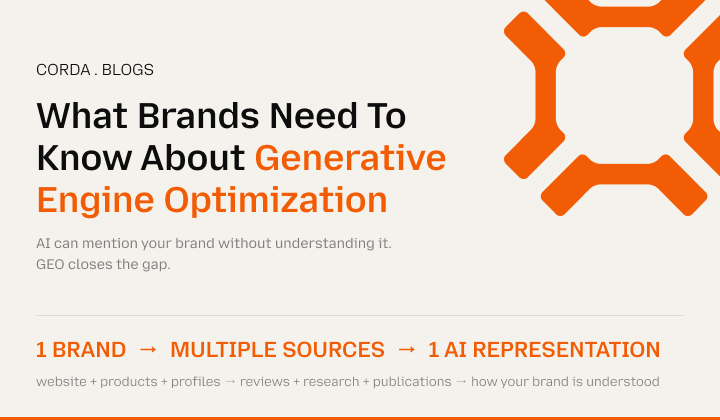
These sources can collectively contribute to how a brand is represented.
So the GEO question isn’t simply ‘how do I optimize this page for AI?’
Instead, it is ‘Does the web contain enough clear and credible information for an AI system to understand what this brand is, what it offers, and where it fits?’
That is a much bigger question.
Why GEO Matters To Brands?
People don’t always search with a product name anymore. Instead, they may start with a problem.
For example, ‘What are the best SEO platforms for an agency managing 50 clients?’ Then they might ask, ‘Which ones offer competitor analysis?’
Then ‘What are some alternatives to Semrush?’
The brand discovery process can happen inside that conversation.
A company might never receive the traditional click it was optimizing for. Yet its name, product, or research may still influence the person’s decision.
That creates a new form of visibility. Your brand doesn’t just need to be findable. Instead, it needs to be understandable.
GEO Is Not SEO For ChatGPT:
This is one of the biggest misconceptions around GEO.
There isn’t one universal optimization formula that makes a brand visible across every generative search system.
Moreover, different systems can use different models, search indexes, retrieval methods, sources, and processes.
Also, optimizing specifically for one platform can therefore become a short-term tactic.
A stronger strategy is to improve the underlying information about your brand. That means making your website and wider digital presence:
- clear
- consistent
- useful
- specific
- well-supported
- technically accessible
- easy to interpret
Those improvements can benefit traditional search as well.
Your Brand Needs A Clear Identity:
Generative systems need to distinguish entities.
As a result, if your company has a generic name, several products, multiple locations, or a complicated corporate structure, this becomes especially important.
Also, your website should make basic information obvious.
- Who are you?
- What do you sell?
- Who do you serve?
- Where do you operate?
- Which products belong to you?
- Who are the people behind the company?
- What category do you operate in?
These aren’t exciting SEO questions. Instead, they are fundamental brand questions. And they matter because vague positioning creates ambiguity.
As a result, something like ‘We empower businesses through innovative technology solutions’ tells a system very little.
However, ‘we provide payroll software for small businesses in India, including automated salary calculations, tax deductions, and employee payslips’ is much easier to understand.
The second description is also better marketing. That’s the point.
Additionally, GEO often rewards the same clarity that good brand communication already requires.
Consistency Across The Web Matters:
Your homepage might describe your company one way. Your LinkedIn page might use another description.
Then, an industry directory might categorize you differently. A review website might describe an older version of your product.
And a publication might use an outdated company name. Some variation is inevitable. But major inconsistencies can make your brand harder to interpret.
So, it’s always best to run a simple brand-information audit.
Search your company name and record:
- company descriptions
- product names
- categories
- locations
- founders
- pricing information
- major claims
- external reviews
- outdated information
You may find that your biggest GEO problem isn’t your content strategy. Instead, it is inconsistent information about the company.
Your Website Is Only One Part Of The Story:
This is where GEO becomes different from conventional on-page optimization.
Your company controls its website. It does not control every source that discusses it.
Generative systems can encounter information through third-party sources such as publications, reviews, research papers, directories, forums, and industry websites.
That means a brand’s digital footprint extends beyond its own domain.
For example, suppose your website says your software is designed for enterprise companies. But ten independent reviews describe it primarily as a tool for small businesses.
That discrepancy creates a different picture of the brand.
You cannot solve every external inconsistency yourself. But you can identify them. And that is why brand monitoring becomes part of GEO.
Original Information Gives Your Brand Something To Contribute:
The web already contains thousands of articles explaining the basics of most industries. Another generic article rarely changes that.
Original information does.
As a result, brands can create valuable source material through:
- original research
- proprietary datasets
- customer surveys
- industry benchmarks
- experiments
- case studies
- expert interviews
- product data
- annual reports
- first-hand observations
So, imagine an SEO platform publishes a study analyzing 100,000 search results. That research can become a source for other publications.
Then, those publications may reference the study. The brand has created something that exists beyond its own marketing copy. That is a much stronger foundation for long-term visibility.
Stop Writing Only About What You Sell:
A common brand-content strategy looks like this: Product page → product blog → product feature → product blog → product comparison.
Everything points back to the sale. And that’s understandable.
But it can create a very narrow information footprint. Brands should also publish information around the problems their customers are trying to solve.
A cybersecurity company could publish research about emerging threats. A payroll company could analyze salary trends. An SEO platform could study search behavior.
The subject doesn’t need to be a disguised advertisement.
In fact, it is often more useful when it isn’t. The brand becomes associated with useful knowledge rather than simply promotional content.
Comparison Content Becomes More Important:
Generative search is particularly useful for questions involving choices. You will see people asking questions like:
- Which tool should I use?
- What are the alternatives?
- Which platform is better for a small business?
- What’s the difference between these products?
- What should I consider before switching?
Brands that refuse to discuss these questions leave an information gap. That doesn’t mean publishing pages that attack competitors.
Moreover, useful comparison content should explain:
- differences in features
- pricing structures
- ideal customer profiles
- limitations
- integrations
- implementation requirements
- use cases
- situations where each option makes sense
And don’t be afraid to explain where another product may be a better fit.
A comparison becomes more useful when it helps someone make a decision rather than simply declaring one product superior.
Make Claims Easier To Verify:
GEO makes unsupported marketing claims even less useful. For instance, consider ‘Our platform makes SEO 10x faster.’
That’s a claim.
Now consider ‘Customers using our automated reporting workflow reduced monthly reporting time by an average of 62% across a six-month sample of 84 accounts.’
That’s a claim with evidence.
The second statement gives the reader something to evaluate. Where possible, support important claims with:
- methodology
- dates
- sample sizes
- case studies
- original data
- named sources
- limitations
Don’t turn every sentence into an academic paper. Instead, just make important claims defensible.
Structured Data Can Help Clarify Entities:
Schema and structured data can support the broader GEO strategy by providing machine-readable information about entities.
Depending on the page, this might include:
- Organization
- Person
- Product
- Article
- LocalBusiness
- BreadcrumbList
The key is accuracy.
Structured data doesn’t force an AI system to mention your brand. It doesn’t create authority by itself. And adding every possible schema type isn’t a GEO strategy.
Instead, use it to reinforce information that already exists on the page.
Backlinks Still Have A Role:
GEO doesn’t make traditional authority-building irrelevant. External references can still help establish a brand within its broader ecosystem.
But don’t reduce this to something like ‘Get backlinks so AI will cite you.’
That is too simplistic.
A relevant publication referencing your original research can do several things at once.
It can introduce your brand to new readers, create referral traffic, provide an external reference, and strengthen your association with a particular subject.
That is more valuable than treating the link as a single SEO point.
Moreover, the same principle applies to digital PR and industry coverage. The goal is not to manufacture mentions.
Instead, it is to become a source worth mentioning.
Being Mentioned Is Not The Same As Being Understood:
This distinction is easy to miss.
So, suppose an AI system mentions your company. Now, that’s visibility. But what if it describes your product incorrectly?
Or attributes a competitor’s feature to your company? Or uses outdated pricing? Or puts your business in the wrong category?
A mention alone isn’t necessarily useful. At the end of the day, brands should monitor accuracy as well as visibility.
That means asking:
- Are our products correctly described?
- Are our differentiators accurate?
- Is our brand name correct?
- Is our category correct?
- Are outdated claims appearing?
- Are competitors being confused with us?
GEO should therefore include a reputation and information-accuracy component.
How To Measure GEO?
Measuring GEO can be difficult because generative systems don’t always provide a simple visibility metric.
Instead of relying on one score, create a repeatable prompt set, including:
- Category prompts: What are the best project management tools for remote teams?
- Problem prompts: How can a small agency manage SEO reporting?
- Comparison prompts: Compare Brand A and Brand B for an enterprise team.
- Alternative prompts: What are alternatives to Brand A?
- Brand prompts: What is Brand A and what does it offer?
- Recommendation prompts: What tools should a 50-person company consider for customer support?
Then record:
- whether the brand appears
- how frequently it appears
- which competitors appear
- how the brand is described
- which sources are referenced
- whether important information is accurate
Repeat the same prompt set periodically.
Also, don’t compare results from completely different questions and call the difference a GEO improvement. Why? Because consistency makes the measurement more meaningful.
Don’t Create AI Content:
This is probably the easiest trap to fall into.
A company hears about GEO and starts producing hundreds of pages designed around every conceivable question.
The result is often predictable.
- Thin content.
- Repetitive answers.
- Awkward headings.
- Keyword variations.
- Generic summaries.
Pages that exist because a tool identified another phrase to target.
That isn’t a GEO strategy. To be fair, generative systems already have access to enormous quantities of generic information.
Your opportunity is to create better information, not more pages.
GEO Starts With Better Brand Information:
So, if your brand is difficult to understand, adding more content won’t necessarily solve the problem.
You need to start with the basics. For that, make sure your:
- company description is clear
- product information is accurate
- authors are identifiable
- important claims have evidence
- comparisons are useful
- key pages are internally connected
- structured data is accurate
- external profiles are consistent
- outdated information is corrected where possible
Then build outward. Publish original research, create genuinely useful resources, and earn relevant third-party coverage.
Also, answer questions your customers actually ask. This creates an information footprint with substance behind it.
GEO And SEO Should Work Together:
You don’t need two completely separate marketing departments.
Much of good SEO already supports GEO.
- Technical accessibility helps both.
- Clear content helps both.
- Strong internal linking helps both.
- Original research helps both.
- Relevant backlinks help both.
- Entity clarity helps both.
The difference is the way you evaluate success.
Traditional SEO asks, ‘Can this page rank for the query?’ But GEO adds, “Can a generative system understand and accurately represent what this brand knows?”
Those goals overlap, but they aren’t identical.
The Bigger Shift Is From Rankings To Brand Representation:
This is the part brands should pay the most attention to.
Search visibility used to be relatively easy to picture. You had a keyword. You had a ranking. And you had a click.
Generative search creates another layer.
A person may encounter your brand through an AI-generated explanation, recommendation, comparison, or summary.
That means your brand needs more than a collection of optimized URLs.
It needs a coherent body of information.
This means your products need to be clearly described, your expertise needs evidence, and your differentiators need substance.
Also, the information available about your company needs to be consistent enough to support an accurate understanding.
GEO isn’t about finding a secret formula for getting mentioned by AI. Instead, it is about making your brand easier to understand and your information easier to trust and use.
That starts with the fundamentals: clear positioning, useful content, original information, credible references, accurate entity data, and a consistent presence across the web.
Traditional SEO still matters.
But as search becomes more conversational and generative, brands need to think beyond where their pages rank.
Also, they need to think about how their brand appears inside the answer. The future of search visibility isn’t only about being found. It’s about being understood correctly.