

Results At A Glance
| Area | Project context |
| Business | Global cybersecurity and IT infrastructure provider |
| Market | Enterprise technology and cybersecurity |
| Primary focus | Strengthening digital authority and identifying relevant publisher opportunities |
| Intelligence | Website analysis, competitor research, and authority gap identification |
| Campaign planning | AI-assisted publisher discovery and prioritization |
| Execution | Brand-controlled campaign planning and tracking |
Company scale: 100,000+ customers worldwide, 7,000+ employees, and 70+ global branches. These are Sangfor’s company-level figures, not results generated by this engagement.
Building Digital Authority In A Competitive Cybersecurity Market
Brand trust and online credibility are paramount in the cybersecurity market. Clients in this industry will not be convinced by tall marketing claims or simple service descriptions. So what is the solution?
Clients seek proven industry references and editorial mentions that build trust in the brand. Here, organic placements work as independent information that most cybersecurity clients actually trust and seek.
On that note, let us remember that Sangfor is already an established cybersecurity brand. They have brand reach across the global online space and a physical presence in consolidated markets like APAC, EMEA, and Latin America.
What Are Sangfor’s Main Service Niches?
The brand is mainly known for its cybersecurity services. Other key service niches include cloud tech and cloud computing, EPP, ransomware analysis and coverage, and other integrated cloud security management solutions.
Hence, one thing is clear. The niche audience for different service types varies. As a result, Sangfor needs different targeting and authority-building strategies to reach different niche markets and buyer personas.
Why Sangfor Needs Global Authority Building Now?
The company’s service architecture is expanding. At the same time, the brand wants new audiences and competitors’ audiences to learn about the new products and service niches.
At the same time, we need to create higher brand visibility in discussion forums, editorial content and industry-level conversations. This is one feasible way to make the brand name resonate in online mentions and send Google trust signals.
Hence, Sangfor’s primary focus was building higher search authority. As a brand that has worked with us for over 2 years, we were happy to introduce our flagship authority-building product to Sangfor.
As one of Corda’s initial clients, the challenge of helping the platform perform and drive conversions through authority building was immense.
Any average agency would shove backlinking as the solution for better online authority. However, Corda is much more than that.
First, Corda analyzed competitor gaps. These gaps are the credibility gaps that Sangfor has, but competitors have recovered.
Next, Corda identifies opportunities that align with Sangfor’s digital directives.
The Challenge: Turning Digital Authority Gaps Into Action
A brand operating in enterprise cybersecurity faces a different visibility challenge from a general consumer business.
Its audience includes IT decision-makers, security professionals, enterprise technology teams, and business leaders. These audiences search for specific solutions, compare providers, evaluate technical capabilities, and research potential security risks.
Building visibility across these audiences requires a focused approach.
For Sangfor, the work centred on several important areas:
1. Understanding The Existing Authority Position
Before planning a campaign, the brand needed a clearer view of its existing website authority, backlink profile, and overall digital presence.
2. Identifying Where Competitors Excel
In Sangfor’s case, we found that competitors generally have better visibility across key security areas and broader product categories. They have niched down into areas like XDR, MBR, and EDR and gained authority in those niches. That’s how we directed our authority-building efforts.
3. Matching The Best Publishers From The Inventory
Corda provides an authority score for each publisher. However, we urge all clients to check the publisher’s industry reach, the target audience it serves, and how existing placements have performed.
4. Prioritizing Campaign Opportunities
Again, choosing a list of good publishers does not guarantee your brand will get the expected campaign benefits.
At the same time, you need to ensure the publisher’s brand, the content published, and the website where the content appears add organic value to the client’s brand and the pages being promoted. In this case, we are prompting towards Sangfor.
However, mature SEO agencies have that horizon of understanding that lets them differentiate a good publisher on paper from a really effective one. In Sangfor’s case, the client believed in Corda’s judgment.
Introducing Corda: An AI-Powered Authority Intelligence Platform
Corda brings website analysis, competitor intelligence, publisher discovery, and campaign planning into one connected workflow.
Instead of treating SEO metrics and publisher lists as separate activities, the platform connects them to help brands understand their authority position and identify opportunities for improvement.
For Sangfor, the approach followed a straightforward principle:
Understand the gaps. Find the right opportunities. Prioritize the work. Build campaigns around business objectives.
The process combined automated analysis with human decision-making. Sangfor’s team remained responsible for defining objectives, setting priorities, selecting target pages, and providing strategic direction.
The Process: From Website Analysis to Campaign Planning
Check out how the Corda’s authority building process worked out for a cybersecurity company of global scale like Sangfor:
Stage 1: Website Analysis
The first step was understanding the website’s existing digital position.
Website Analysis provided a starting point for examining the brand’s authority signals, backlink profile, and website-level performance indicators.
For a cybersecurity company, this assessment matters because different product categories can have different search requirements.
A website may have established domain authority while individual product pages or solution categories still have opportunities to improve visibility.
The objective was to understand the current position before deciding where to direct additional effort.
Stage 2: Competitor Analysis
Competitor analysis is a key step that determines the quality of your campaign profile. In Sangfor’s case, this stage determined which market elements to focus on.
The factors decided at the end of the stage included website authority, search credibility, and backlink profile quality.
Their team made the call when it was their turn to decide whether a backlink profile was credible.
Stage 3: Authority Gaps
A competitor having more backlinks does not automatically mean that a brand needs more backlinks. The important questions are:
- Which pages need stronger authority?
- Which topics have greater competitive pressure?
- Where are relevant publishers already covering the industry?
- Which opportunities align with the brand’s business priorities?
This stage helped create a more focused basis for campaign planning.
Stage 4: Publisher Opportunities
After identifying potential gaps, the process moved towards publisher discovery.
The objective was to find publishing opportunities that aligned with the brand’s industry, target audience, and campaign requirements.
Publisher evaluation considered relevant indicators such as:
- Domain Rating (DR)
- Domain Authority (DA)
- Organic traffic
- Ranking keywords
- Industry relevance
- Publisher pricing
- Overall publisher quality
For a cybersecurity brand, contextual relevance matters most.
A placement on a technology or enterprise security publication can offer a more relevant editorial environment than a high-authority website with little connection to the subject.
The aim was to identify publishers that could support the brand’s authority-building objectives, not simply increase the number of referring domains.
Stage 5: Prioritization
Sangfor did not choose the manual build option on Corda. But suppose you did that. Now, how can you ascertain which publishers deserve how much attention. Corda has a clear breakdown for that, too.
That will be selected based on the campaign requirements you shared as input at the beginning. Here, Sangfor’s team prioritized each publisher’s authority and organic reach, its relevance to the cybersecurity industry, and other key indicators Corda was analyzing.
Stage 6: Campaign Builder
Once the team evaluated the opportunities, the next step was to translate them into a campaign structure.
Campaign Builder brought the selected opportunities and campaign requirements together.
The brand team could define important campaign inputs, including:
- Target website pages
- Relevant topics
- Anchor text requirements
- Content briefs
- Publisher selections
- Placement budgets
- Campaign priorities
This provided a more organized way to plan authority-building activities.
Rather than managing publisher research, campaign requirements, and execution planning as disconnected tasks, the team could work through a connected campaign workflow.
Stage 7: Content and Placement Planning
In cybersecurity, a placement’s subject and context matter.
A campaign targeting enterprise security audiences needs content that is relevant to the publication and useful to its readers.
Content and Placement Planning therefore focused on aligning the selected publisher opportunities with the campaign’s content requirements.
The planning process considered:
- Editorial topic relevance
- Target page selection
- Anchor text placement
- Content briefs
- Publication requirements
- Contextual relevance
This helped ensure placement decisions considered the content and destination pages they were intended to support.
Stage 8: Campaign Execution
At the start of this stage, we had the campaign architecture. The next step was for Corda AI to design and implement the execution of the campaigns as planned.
However, here is the interesting part. Before sending the campaign, the brand’s marketing & PR team could review each campaign’s final structure before it actually went out. That’s how Corda ensures that the final control is with the client itself.
The client reps manually reviewed opportunities and publishers based on available options, the specific pages that needed promotion, and the accuracy of placements for each page or vertical’s niches.
Stage 9: Tracking and Refinement
Stage-wise tracking and review is a crucial part of Corda’s service interface. Thats why we say: “The Control Is In Your Hands.”
From time to time, the Sangfor team reviewed placements to confirm whether their brand KPIs were fulfilled.
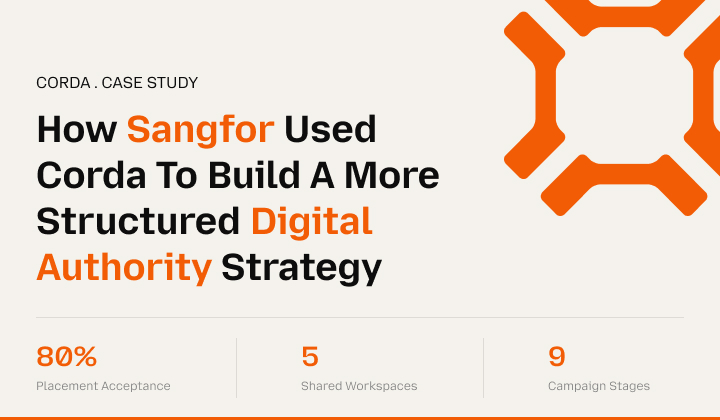
At the same time, they could adjust campaigns through the 5 shared workspaces they could manage under a single subscription.
As a result, the campaign error rate dropped, and campaign results improved sharply.
What Made The Approach Different?
The key difference was connecting authority intelligence with campaign planning.
Traditional approaches can involve several disconnected activities:
- Checking website metrics in one tool.
- Researching competitors in another.
- Finding publishers through separate databases.
- Comparing publisher prices manually.
- Managing campaign requirements through spreadsheets.
- Tracking execution across different systems.
This creates additional work and makes it harder to connect research with campaign decisions.
The platform-led approach brought these activities into a more connected process.
1. Decisions started with website intelligence.
Campaign planning began with an understanding of the existing website position rather than an arbitrary backlink target.
2. Competitor data provided context.
The analysis considered where competitors had stronger authority signals and where additional opportunities might exist.
3. Publisher discovery was connected to relevance.
Publisher selection considered more than domain metrics, keeping industry alignment and campaign requirements in focus.
4. The brand retained strategic control.
Automation supported analysis and discovery, while the brand team determined objectives, priorities, target pages, and final campaign decisions.
5. Campaign planning became more organized
The connected workflow helped bring research, publisher selection, content requirements, and campaign tracking into one process.
The Bigger Picture: Why Digital Authority Matters For Cybersecurity Brands
Most cybersecurity clients are retained based on trust. Cybersecurity clients take time to shower confidence in any new product or service vertical. The same thing was happening with Sangfor.
Clients needed authentic trust signals showing Sangfor is globally getting the hype the brand was reiterating through SEO. At the same time, we were leveraging Corda to build better search visibility across all important subject areas.
In particular, we didn’t want to concentrate all traffic on the homepage, as many average cybersecurity companies do.
Hence, we distributed the authority through clever placements evenly across all of these niches:
2. Endpoint protection
3. Threat detection
4. Cloud security
5. Enterprise infrastructure
Interestingly, for Sangfor, each of these service niches has a separate target customer base and unique search preferences. That’s why we needed a different publisher list for each vertical.
How Sangfor Ensured Better Campaign Decisions?
For Sangfor Corda, we analyzed gaps, sought vetted opportunities, and curated placements.
The goal was to promote the separate service verticals and reach as many untapped market segments and niche audiences as possible who may be interested in tier flagship products.
So backlink volume is a redundant metric here. Link quality and the link ecosystem mattered more for Sangfor.
Corda analyzed the domain, studied competitor profiles, and then selected the most relevant placements. The Sangfor team agreed with 80% of the placements suggested.
The Sangfor case study is proof that Corda can adopt a brand-oriented authority management project seamlessly. The best part is that the platform can do so without manual intervention.
If you want to explore how Corda can deliver value to your brand and build a better authority profile: