

Search rankings can make SEO look like a scoring system.
- Add the right keywords.
- Build backlinks.
- Improve page speed.
- Add schema.
- Publish more content.
Then, you just have to wait for Google to take a call on whether your page is valuable enough – and if your page passes Google’s evaluation, then your content will feature at the top of SERPs.
Frankly, it does not work that easily – it’s not a formula that always generates the same results.
In reality, the decision-making part by Google and other search engines is much harder. Because when someone looks up something on the internet, you have to understand that hundreds of pages could pop up containing relevant information.
But it is the job of search engines to find out which results are actually valuable – and that too for that particular search query and context.
This naturally means ranking is not always about having more SEO signals in comparison to your competitors.
Instead, it is also about giving Google and other search engines enough proof to understand what your page actually has to offer.
More importantly, how well your page answers a particular search query plays an essential role in Google’s ranking algorithm as well.
In this context, this blog will break down SEO rankings for you and highlight how Google determines which websites deserve to rank.
Stay tuned.
Search Engines Don’t Rank Websites In Isolation:
Now, this is a very common misconception in the SEO landscape, especially amongst new SEO professionals.
Most people assume that websites have a fixed ranking spot. However, the reality is very different – your site can rank in the top spot for one query and not rank for another query.
Similarly, your site can rank on the first page for one query and rank on the 5th page for another query.
Even the same query can produce different results depending on factors such as location, language, device, freshness requirements, and other aspects of search context.
So wondering how to make your website rank higher is less useful than asking, ‘Why would this particular page be a good result for this particular search?’
That question gets much closer to how modern search works.
The First Job Is Understanding The Query:
Before a search engine can choose a result, it needs to understand what the person is looking for.
For instance, someone searches ‘best running shoes for flat feet.’ Now, this person is not looking for information on the history of flat feet or running shoes.
Instead, this person is looking for product recommendations, brand comparisons, and guidance about a specific problem.
Now consider, ‘what causes flat feet?’ The underlying topic is similar. But the desired answer is not.
And this is precisely why just matching your keyword is not going to cut it – you can stuff a page with every relevant keyword related to your topic, and the page can still fail to perform.
Why? Because the page does not have the information to satisfy the search intent.
Search Intent Is More Complicated Than Four Labels:
SEO guides often divide search intent into:
- informational
- navigational
- commercial
- transactional
These categories are useful as a starting point. But real searches aren’t always that clean. As a result, someone searching for ‘best CRM for small business,’ may want a comparison.
They may want pricing. They may want screenshots. Also, they may want alternatives. And that’s not all – someone might want to know about the product’s integrations with existing tools.
TBH, the search query itself does not always reveal every question behind it.
Strong pages anticipate the practical information the searcher needs next.
And that’s a major reason why pages that define a topic simply often struggle against pages that actually help someone make a decision.
Search Engines Evaluate The Page, Not Just The Keyword
A page isn’t a bag of keywords.
It has structure, context, claims, links, authorship, media, supporting information, and relationships with other pages.
Search systems can use many different signals to understand these elements. For example, a page about enterprise cybersecurity might demonstrate its subject through:
- detailed explanations
- relevant terminology
- examples
- original research
- supporting sources
- author information
- related pages
- references from other websites
Having said that, you have to understand that it is risky to treat these elements like some magical ranking formula.
However, together, these elements do make a page much easier for search algorithms to understand and evaluate.
Content Quality Is About More Than Length:
Longer content isn’t automatically better content.
For instance, a 5,000-worded article can answer a question badly, and a 1,500-worded article can answer the same query very well.
What actually matters is whether a piece of content is helpful for the readers – whether it offers useful information for a specific query.
To be fair, any good page will never make readers hunt for the answer. Instead, a good page always explains the important concepts clearly.
Also, a good page covers meaningful edge cases when they matter, distinguishes facts from assumptions, and gives the reader something they can actually use.
That is very different from writing a specific word count because an SEO tool recommends it.
Original Information Gives A Page Something To Contribute:
Search engines have access to enormous amounts of repetitive content.
As a result, if ten thousand pages explain the same basic definition, another page repeating that definition doesn’t add much.
Original information changes the equation. And that could mean:
- first-hand observations
- proprietary data
- original research
- experiments
- case studies
- unique examples
- expert analysis
- comparisons based on actual experience
- new interpretations of existing information
This is one reason non-commodity content matters.
You are not simply trying to create another page about the topic. You are trying to create a page that has something worth discovering.
Experience Can Change The Value Of A Page:
So, imagine two articles explaining how to migrate a website.
One summarizes documentation and existing SEO advice. The other explains what happened during an actual migration, including:
- which URLs changed
- what went wrong
- how redirects were handled
- what happened to traffic
- which errors appeared
- how long recovery took
The second article contains information that readers cannot get simply by reading ten generic SEO guides.
That first-hand detail can make content substantially more useful.
This is one reason experience matters when creating content in areas where practical knowledge changes the answer.:
Links Provide External Context:
Search engines have long used links as an important source of information. A link can act as a reference between two websites or pages.
But the value of a link isn’t captured completely by counting backlinks.
So, consider a research report cited by several respected publications in the same industry. Those references provide useful external context.
Now compare that with hundreds of links from unrelated websites that have little connection to the topic.
The second profile is larger. The first may tell a much clearer story about the site’s place within its subject area.
This is why link analysis should consider relevance, context, source quality, and the pages receiving links rather than treating backlinks as points.
Internal Links Help Search Engines Understand Relationships:
Internal links are often treated as a way to distribute PageRank. Also, they do something more basic – they show how your own content fits together.
So, suppose a website has a comprehensive guide to technical SEO. It links to detailed pages about:
- crawlability
- indexing
- canonical tags
- JavaScript SEO
- structured data
- log file analysis
Those relationships help establish the site’s information architecture.
The pages are not isolated articles. They form a connected body of information. And that structure can help both users and search engines discover related content.
Authority Is Built Across A Website:
A single page can rank without the entire domain being famous. But websites can also develop broader topical and entity-level recognition over time.
A site that consistently publishes useful material about technical SEO, for example, creates a much clearer subject identity than a site that publishes unrelated articles about SEO, cooking, finance, travel, and celebrity news simply because each topic has search volume.
That doesn’t mean niche websites always outrank broader publications.
Large publishers can rank across many subjects.
The practical point is that a website’s overall context can shape how search engines understand its individual pages.
Technical SEO Removes Obstacles:
Technical SEO matters. But much of it works differently from how SEO checklists make it sound.
A technically sound website doesn’t automatically become authoritative.
Instead, technical problems can prevent search engines from properly accessing, understanding, indexing, or serving pages.
Think about:
- crawlability
- indexability
- canonicalization
- redirects
- mobile rendering
- page performance
- JavaScript
- internal linking
- duplicate content
- structured data
Also, fixing a major technical problem can therefore unlock existing value. It doesn’t necessarily create that value from nothing.
A perfectly optimized page that search engines can’t crawl is still a problem. A technically flawless page with nothing useful to say is a different problem.
Search Results Are Also About Competition:
Your page isn’t evaluated against an imaginary standard of perfection. It exists in a competitive search environment.
So, suppose your page is genuinely useful. But another page:
- answers the query more directly
- provides stronger original evidence
- has clearer information architecture
- covers important decision points
- comes from a more established source
- better matches the searcher’s intent
Your page can still lose the position. This is why SEO audits should include competitor analysis.
As a result, don’t just ask ‘Is our page good?’ Instead, ask ‘What useful information does the competing page provide that ours doesn’t?’
That question often produces much better improvements.
Ranking Isn’t A Permanent Achievement:
Even if a page reaches position one, the work isn’t necessarily finished.
Search results change → Competitors publish new information → Search intent changes → Information becomes outdated → Search engines improve their systems → New types of search experiences appear → A page that ranked well for years can eventually lose visibility.
This is why sustainable SEO is less about finding one perfect optimization and more about continuing to maintain the page’s usefulness.
Why Some Pages Rank Without Perfect SEO?
You have probably seen pages with mediocre page speed, weak metadata, imperfect heading structures, few exact-match keywords, and relatively simple design still ranking well.
Of course, that does not mean on-page or technical SEO does not matter. Instead, it means ranking algorithms evaluate many signals together.
For instance, a page can have strengths that compensate for weaknesses elsewhere. Perhaps it answers the query exceptionally well. Perhaps it has strong external references. Or perhaps the website has deep expertise in the subject.
This is why copying another site’s title tag or adding a few keywords rarely reproduces its rankings.
Of course, you can copy visible elements. However, you can’t easily copy the underlying reasons people and websites trust that source.
Search Engines Are Trying To Solve A Selection Problem:
At its core, ranking is a selection problem.
A search engine has many possible results. It needs to decide which ones are most useful for a particular search.
That involves understanding:
- What is the query about?
- What does each page contain?
- How closely does each page satisfy the need?
- How trustworthy and useful does the source appear?
- What external and internal context supports the page?
- What other results are available?
The exact systems and signals used to make those decisions are complex and continuously evolving.
That’s why nobody outside the search engines can honestly give you a complete, permanent list of the ranking factors.
Instead, what you can do is create valuable pages that offer search systems solid relevance consistently – the point is to create helpful content that adds value.
The Easiest Way To Deal With A Ranking Problem:
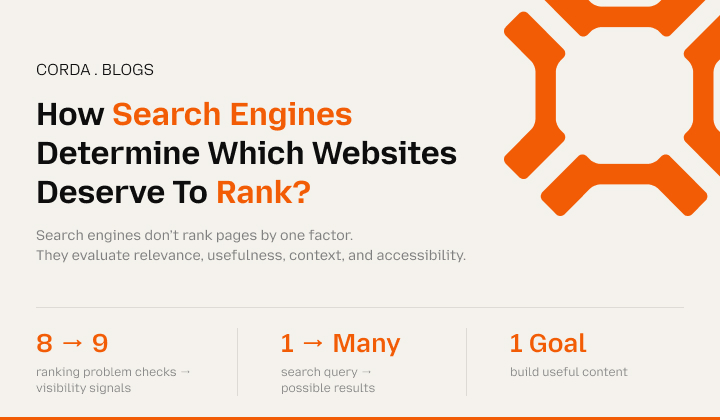
When a page isn’t ranking, don’t immediately add more keywords. Instead, work through the problem in this order.
1. Check whether the page matches the query: Would someone searching this term actually want this page?
2. Examine the competing results: What are the current top results doing that your page isn’t?
3. Check the quality of the answer: Does the page genuinely solve the searcher’s problem?
4. Look for original value: What does your page offer that another page doesn’t?
5. Check the site’s topical context: Does the website have a meaningful relationship with this subject?
6. Examine external references: Are relevant websites naturally referencing your content?
7. Check technical barriers: Can search engines crawl, render, index, and understand the page correctly?
8. Revisit the page over time: Has the information become outdated?
This approach is much more useful than running through a checklist of 200 supposed ranking factors.
So, What Makes A Website ‘Deserve’ To Rank?
Deserve isn’t a technical score that search engines assign. It’s a useful way to frame the underlying goal.
As a result, a page has a stronger case for visibility when it can demonstrate:
- clear relevance to the query
- a useful answer
- appropriate depth
- accurate information
- original value where possible
- credible sourcing
- meaningful expertise or experience
- strong internal context
- relevant external references
- sound technical accessibility
Not every page needs all of these elements to the same degree.
A breaking-news article and a product page have different requirements. Similarly, a medical reference page and a local restaurant page have different purposes.
The signals that matter depend partly on what the searcher is trying to accomplish. Search engines don’t simply reward websites for completing an SEO checklist.
Instead, they have to decide which pages provide the best available answers for a particular search.
That requires understanding relevance, content, entities, context, links, technical accessibility, freshness, and many other signals.
So instead of asking, ‘What ranking factor are we missing?’ ask, ‘What evidence does our page give a search engine that it is a useful result for this search?’
That shift changes SEO from a checklist into a much more meaningful exercise.
The goal isn’t to manufacture ranking signals. It’s to build a page that has a credible reason to appear when someone needs what it provides.