

Imagine you’ve spent weeks improving a website’s rankings. Your pages are performing well on Google, your backlink profile is growing, and organic traffic is moving in the right direction.
Then your manager asks a few new questions:
- Does our brand appear in Google AI Overviews?
- Does ChatGPT recommend our product when someone asks for suggestions?
- Are competitors getting mentioned more often in Perplexity?
- When AI tools describe our business, are they getting the facts right?
You open another dashboard, run a few searches and start collecting more data. But now you have another problem: What should you work on first?
This is one of the biggest challenges in SEO for AI search. SEO teams have several platforms to monitor, a lot of numbers to track and more tasks to complete.
But having more information doesn’t always make it easier to decide what to do.
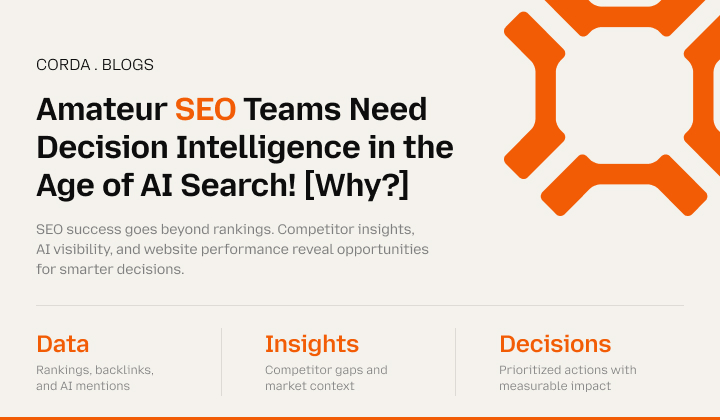
That’s where Decision Intelligence comes in. It helps SEO teams understand their data, find the problems that matter most and decide what to fix first.
Let’s look at how it works and why it matters.
What Is Decision Intelligence In SEO?
Decision Intelligence is a way of using data to make better business decisions.
In SEO, it means looking at information from different sources and using it to decide which action deserves attention first.
For example, imagine you’re managing a website that has lost visibility for an important keyword. You could:
- Check its current Google ranking.
- Review its content and backlinks.
- Compare the page with competitors.
- Check whether AI platforms mention your brand for related searches.
These checks give you information. But they don’t automatically tell you what to do. Meanwhile, Decision Intelligence connects the findings and helps you identify the next step.
For example:
| Finding: | Three competitors are getting mentioned in ChatGPT for a product-related query, but your brand isn’t. |
| Possible reason: | Their websites have stronger product information and more relevant third-party mentions. |
| Recommended action: | Improve your product page, review the sources mentioning those competitors and identify relevant websites where your brand could earn a mention. |
That’s the difference between collecting SEO data and using it to make a decision.
Adthena uses a similar idea in paid search. It connects live advertising data with information about competitors and the wider market. Then helps teams identify what they should do next.
SEO teams can apply the same approach to organic search and AI visibility.
Decision Intelligence VS Traditional SEO Reporting
Most SEO teams already use dashboards and reports. So, why do they need another layer? The difference is what each one helps you understand.
| What you want to know | Traditional reporting | Decision Intelligence |
| Performance | What happened to our rankings? | Why did our rankings change? |
| Competitors | Who ranks above us? | What are they doing better, and can we respond? |
| Backlinks | How many links have we gained? | Which missing links could make the biggest difference? |
| AI visibility | Does our brand appear? | Why are competitors appearing when we aren’t? |
| Next steps | Which numbers need attention? | Which action should we take first? |
A report tells you what is happening. Decision Intelligence helps you understand what to do about it.
What Goes Into A Decision Intelligence System?
A useful system needs five things:
| Data collection: | Bring together rankings, website health, backlinks, competitor activity and AI mentions. |
| Market context | Compare your website with competitors and understand what is happening in your industry. |
| Prioritization | Rank tasks based on their possible impact, the time they need and how confident you are in the findings. |
| Clear recommendations | Explain what needs to change, why it matters and where to start. |
| Performance tracking | Check whether the changes worked and use the results to plan your next actions |
Important Takeaway: Decision Intelligence doesn’t replace an SEO professional. It helps people spend less time sorting through reports and more time making informed decisions.
Why Do SEO Teams Need Decision Intelligence For AI Search?
The way people find information is changing. Someone might search Google, read an AI Overview, ask ChatGPT for recommendations and then compare the answers on Perplexity.
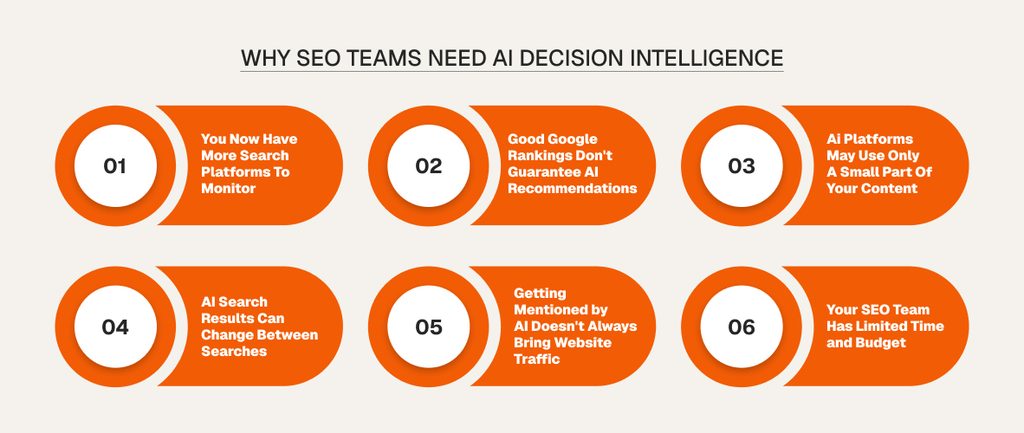
For SEO teams, this creates several new challenges.
1. You Now Have More Search Platforms To Monitor
Earlier, an SEO team could spend most of its time tracking Google rankings, organic traffic and backlinks.
Now, it also needs to understand how its website performs across AI search platforms. Consider a simple example. Someone wants to buy an email marketing tool. They might:
- Search Google for the best email marketing platforms.
- Read the AI Overview for a quick comparison.
- Ask ChatGPT to recommend three tools.
- Use Perplexity to compare their features.
Your brand could rank on Google but still be missing from these AI-generated answers. The reason is that different AI platforms use different information sources.
According to LLMrefs, Gemini relies on Google’s search ecosystem and Knowledge Graph, while Copilot uses Bing’s search index.
This means your visibility can differ between platforms.
| Search platform | What your SEO team should check |
| Google Search | Does your page rank for relevant keywords? |
| Google AI Overviews | Does your content appear in the generated answer? |
| ChatGPT | Does the platform mention or recommend your brand? |
| Perplexity | Does it cite your website or other sources about your brand? |
| Microsoft Copilot | Does your brand appear in its answers? |
You now have more information to collect and compare.
Without a clear way to prioritise the work, teams can spend hours checking different platforms without knowing which problem deserves attention first.
Decision Intelligence helps connect these findings and identify the most important gaps.
2. Good Google Rankings Don’t Guarantee AI Recommendations
Does ranking on Google’s first page mean ChatGPT will recommend your brand? Not necessarily.
Traditional SEO still matters. Surfer, Search Engine Land and Search Engine Journal all explain why technical SEO, useful content and website authority remain important for AI search.
Grow and Convert also discusses the connection between Google rankings and visibility in AI-generated answers.
However, there is another factor: AI platforms don’t simply copy Google’s ranking order.
They select information based on the query, available sources and how relevant they consider each result. Sitebulb discusses this in its write-up of a webinar featuring Jes Scholz and Dan Petrovic.
Dan Petrovic explains this through the idea of a selection rate. In simple terms, it measures how often an AI model selects a brand or website when generating an answer.
He gives an example of a German sports retailer that ranked reasonably well but wasn’t recommended to users outside Germany.
The website had to improve its brand associations and localisation before it started appearing in those recommendations after a model update.
What Does This Mean For SEO Teams?
A missing AI recommendation doesn’t always mean you need more backlinks or better rankings. You may need to:
- Improve the information on your website.
- Make your products and services easier to understand.
- Build stronger brand associations.
- Improve your presence on relevant third-party websites.
- Make your content more useful to people in different markets.
The challenge is finding the actual reason before choosing a solution.
3. Ai Platforms May Use Only A Small Part Of Your Content
You’ve written a 1,500-word article. Does an AI platform read and use every sentence when answering a question?
Not necessarily.
Sitebulb explains that AI search systems can break a user’s question into smaller searches, collect relevant pages, evaluate individual sections and select useful passages for the final answer.
Let’s take an example. You publish an article titled How to Choose the Right CRM Software. It covers:
- What CRM software does
- Different CRM features
- Pricing
- Benefits for small businesses
- A comparison of popular tools
Someone asks ChatGPT: “Which CRM is best for a small business?”
The platform may select only the sections that discuss small-business features, pricing and product comparisons.
The rest of your article may not contribute to that answer. This is why simply publishing longer articles isn’t enough.
SEO teams should check:
- Are the important answers easy to find?
- Do headings clearly explain what each section covers?
- Does the content answer the questions people actually ask?
- Are important facts supported with useful examples?
- Can search engines and AI systems access the content?
Sitebulb recommends using clear headings and information-rich content.
But don’t start rewriting every page without checking it first. Find out which information is missing or difficult to understand, then make the necessary changes.
4. AI Search Results Can Change Between Searches
Try asking ChatGPT the same question several times. You may not always get the same answer.
The recommended brands, cited websites and order of results can change.
This creates a problem for SEO teams that track AI visibility. For example, you check whether ChatGPT recommends your brand for the question:
“Which project management software is best for small businesses?”
Your brand appears in the answer once. Does that mean your AI visibility has improved?
Not necessarily. You need more checks before reaching that conclusion.
In the Sitebulb webinar discussion, Jes Scholz recommends treating prompt-based tracking like a focus group rather than an absolute measurement.
Dan Petrovic also warns against running hundreds of prompts and treating every result as reliable evidence.
His approach uses repeated tests to understand how consistently a model associates a brand with a particular topic.
Here’s a simple way to understand it:
| Test result | What it tells you |
| Brand appears once | A single mention; not enough to establish a trend |
| Brand appears in several repeated tests | A stronger indication of visibility |
| Brand appears consistently across related prompts | A more reliable signal of topic association |
| Brand appears but with incorrect information | Visibility exists, but brand accuracy needs attention |
This is where Decision Intelligence becomes useful.
Instead of reacting to every change, teams can set rules for what counts as a meaningful improvement or decline.
5. Getting Mentioned by AI Doesn’t Always Bring Website Traffic
Here’s another problem. Your brand appears in a ChatGPT answer. But the user doesn’t click through to your website.
Does that mean the visibility has no value? No.
A person might see your brand in an AI recommendation, remember its name and visit your website later. The influence may happen without an immediate click.
This changes how SEO teams should measure performance.
Traditional SEO reporting often focuses on rankings, clicks and organic traffic. AI search adds other questions:
- How often does an AI platform mention your brand?
- Does it recommend you or simply list your name?
- Does it describe your product correctly?
- Which competitors appear alongside you?
- Which websites does it cite when discussing your industry?
Corda’s guide to Generative Engine Optimization explains an important difference: being mentioned by an AI platform doesn’t mean the platform understands your business correctly.
For example, imagine you sell cybersecurity software for businesses. An AI platform mentions your brand but describes it as a consumer antivirus product.
You received a mention, but the description is wrong. That could confuse potential customers. SEO teams should therefore track both AI visibility and brand accuracy.
Share of voice can also help. It measures how much of the conversation or search visibility your brand receives compared with competitors.
By looking at traditional search and AI mentions together, teams can give management a clearer picture of their online presence.
6. Your SEO Team Has Limited Time and Budget
You can’t fix every SEO issue at once.
Your team may have 20 technical issues, 15 content gaps, several competitors gaining backlinks and a growing list of AI visibility problems.
Which one should you handle first? Consider this example before you make your priority list:
| Task | Possible impact | Effort |
| Fix an accidental noindex tag | Very high | Low |
| Rewrite an underperforming service page | High | Medium |
| Publish 20 new blog posts | Uncertain | High |
| Build relevant industry links | High | High |
| Improve missing product information | High | Medium |
The exact priority depends on your website and business goals. But the table gives your team a starting point.
Sitebulb’s webinar discussion includes Scholz’s point about using limited resources wisely. A few strong pieces of content can be more useful than publishing large numbers of weak pages.
Corda’s GEO guide also warns against creating hundreds of thin pages just to target different AI prompts.
The lesson is simple: don’t spend your budget on every possible SEO task. Find the work that has a clear purpose and a realistic chance of improving your results.
What Decisions Should Your SEO Team Actually Make?
So far, we’ve discussed the problems. Now let’s look at the decisions an SEO team should make regularly.
A good Decision Intelligence system should help answer these five questions.
| Question | What your team should investigate? |
| Which SEO issues should we fix first? | Technical errors, blocked pages, rendering problems and missing content |
| Why are competitors getting AI mentions? | Their content, backlinks, brand mentions and cited sources |
| Is AI describing our brand correctly? | Product details, pricing, business category and brand information |
| Which competitor activities matter? | New content, authority growth and changes in search visibility |
| Where are we missing authority? | Relevant publisher mentions, backlinks and third-party references |
For example, if three competitors are getting cited for a particular product-related question, your team should investigate their pages and the sources supporting those answers.
You may discover that they have better product comparisons, more detailed information or relevant mentions on industry websites.
That gives you something specific to work on.
Instead of saying, “We need better AI visibility,” you can say, “We need to improve our product comparison page and earn relevant mentions from industry websites.”
That’s a much clearer plan.
Build Your SEO Foundations Before Optimizing For AI Search
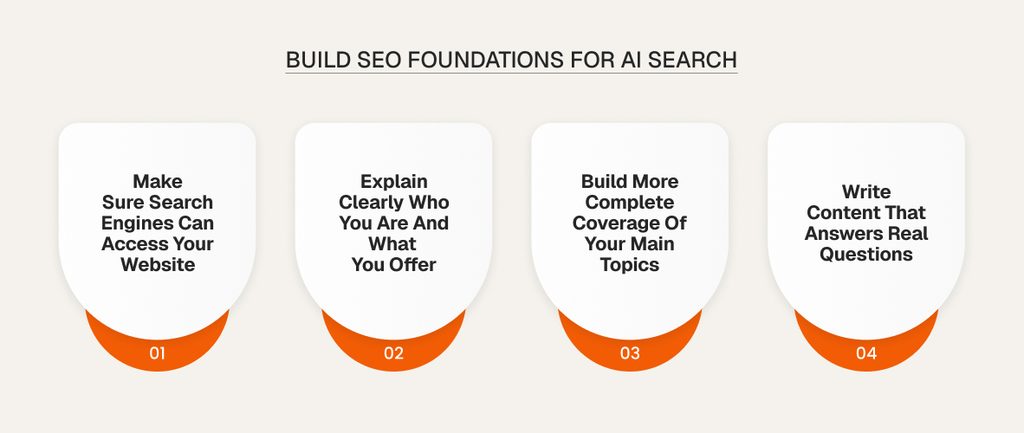
It is tempting to jump straight into AI optimisation. But you should first make sure your website is easy for search engines to access and understand.
Most of the established SEO advice still applies. Here is a practical order to follow.
1. Make Sure Search Engines Can Access Your Website
Start with the technical basics. Check whether:
- Important pages are accessible to search engines.
- Your robots.txt file isn’t blocking important crawlers.
- Important content is available in the page’s HTML.
- Key information isn’t hidden behind elements that search systems may struggle to access.
- Your pages load properly.
Sitebulb’s webinar discussion recommends checking AI bot access, server-side rendering and content hidden in tabs or accordions.
Axonn also highlights clean HTML, fast-loading pages and accessible content.
You don’t need complicated AI optimisation if search systems cannot access the information you want them to use.
2. Explain Clearly Who You Are And What You Offer
Search engines and AI platforms need to understand your business. For example, if you sell accounting software, your website should clearly explain:
- What your product does.
- Who should use it.
- Which problems it solves.
- What makes it different.
- How much it costs, where applicable.
This is where entity optimization becomes useful.
An entity is simply a clearly identifiable person, business, product or topic.
For example, your company is an entity. Your product is another entity. Your industry and the services you offer help explain how these entities relate to each other.
Wellows and Search Engine Journal discuss structured data and entity-based optimisation as ways to help search systems understand these relationships.
Schema markup can also provide additional information about your pages. However, it should support accurate information already present on your website. It cannot create authority on its own.
3. Build More Complete Coverage Of Your Main Topics
Publishing one article about a subject doesn’t automatically make your website an authority on it.
You need useful content that covers the related questions people ask. For example, if your main topic is email marketing, your website could cover:
- What email marketing is.
- How to build an email list.
- How to write email campaigns.
- Email marketing automation.
- Email marketing tools.
- Email marketing costs.
This approach is often called topical authority.
In simple terms, it means covering a subject well enough that search engines can understand your website’s knowledge of that topic.
Surfer discusses topical depth and internal linking as important parts of SEO. Wellows also recommends building topic clusters to connect related pages.
4. Write Content That Answers Real Questions
People don’t always search using short keywords. They ask complete questions, such as:
- Which CRM is best for a small business?
- How much does SEO cost?
- What is the difference between guest posting and niche edits?
Your content should answer these questions directly.
Writesonic highlights conversational content that matches natural language. Search Influence also looks at AI SEO as a combination of technical optimisation, content, entity building and measurement.
You don’t need to fill every article with questions. Just make sure readers can find the information they came for.
Once these foundations are in place, you can start working on how AI platforms understand, select and recommend your brand.
How to Measure Your Visibility in AI Search Without Getting Misled
Now comes the question most SEO managers will ask: How do you know whether your work is improving AI visibility?
You need a consistent way to test your brand across AI platforms. Here is a simple process.
Step 1: Create A List Of Search Prompts
Don’t track random questions every time.
Create a fixed list of prompts related to your business. For example, if you sell project management software, your list could include:
| Prompt type | Example |
| Category | What are the best project management tools? |
| Problem | Which tools help small teams manage deadlines? |
| Comparison | Compare Tool A and Tool B. |
| Alternative | What are the alternatives to Tool A? |
| Brand | What does Tool A offer? |
Corda’s GEO guide also recommends tracking different types of prompts rather than focusing on one question.
Step 2: Record More Than Brand Mentions
A brand mention alone doesn’t tell you much. For every test, record:
- Whether your brand appeared.
- Which competitors appeared.
- Whether your brand was recommended or simply mentioned.
- How the platform described your business.
- Which websites it cited.
- Whether the information was correct.
This helps you understand the quality of your AI visibility.
Step 3: Repeat The Tests
Don’t change your strategy because of one answer. Run the same prompts several times and compare the results.
Look for patterns:
- Does your brand appear regularly?
- Are the same competitors mentioned each time?
- Do the same websites appear as sources?
- Is the platform describing your business correctly?
Consistent results give you a stronger reason to act.
Step 4: Compare Your Share Of Voice
Share of voice helps you understand how visible your brand is compared with competitors.
For example, suppose you track 100 relevant AI responses.
| Brand | Mentions |
| Brand A | 40 |
| Brand B | 30 |
| Your brand | 20 |
| Brand C | 10 |
Your brand has appeared in 20% of the tracked responses.
This doesn’t mean you have 20% of the entire AI search market. It only describes your visibility within the prompts and tests you selected.
That distinction matters when presenting results to management.
Step 5: Fix Problems That The Data Actually Shows
If your brand appears consistently and AI platforms describe it correctly, you may not need to make major changes.
But if competitors repeatedly appear where you don’t, investigate why.
You may need better content, stronger brand mentions, more relevant backlinks or clearer product information.
Measure first. Find the problem. Then decide what to change.
How To Build A Decision Intelligence Process For Your SEO Team
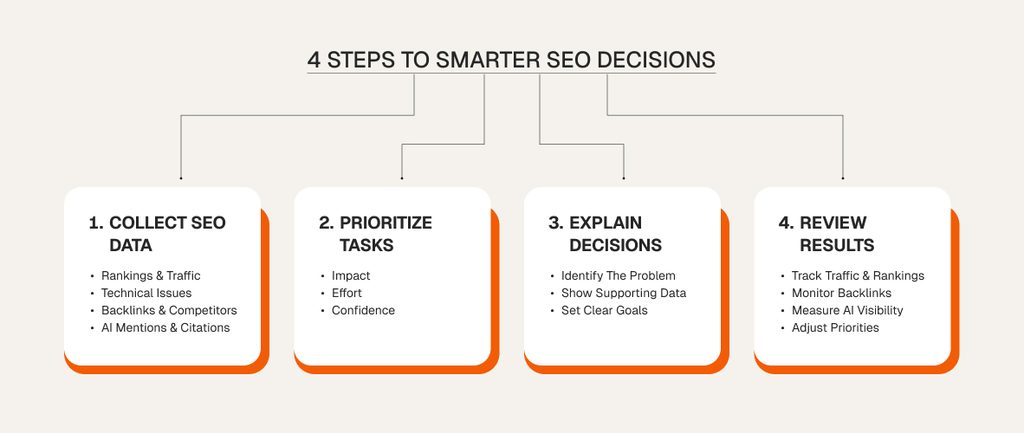
You don’t need an expensive enterprise platform to start using Decision Intelligence. You can build a basic process with the SEO for AI search tools and data you already have.
Follow these four steps.
1. Bring Your SEO Data Together
Collect the information your team already tracks:
- Google rankings and organic traffic
- Technical SEO issues
- Backlink profiles
- Competitor activity
- Content performance
You can start with a spreadsheet if your website and team are small.
The goal is to avoid checking five different reports before understanding one problem.
2. Give Every Task A Priority Score
Not every SEO issue deserves the same attention.
Rate each task based on three factors:
| Factor | What to consider |
| Impact | How much could this improve your SEO performance? |
| Effort | How much time and money will it need? |
| Confidence | How strong is the evidence behind this action? |
For example, fixing an important page accidentally marked as noindex may be a better first task than publishing ten new articles.
The first issue has a clear problem and a direct solution.
3. Explain Why Every Recommendation Matters
Don’t give your team a task without explaining the reason behind it. A useful recommendation should answer:
- What is the problem?
- What evidence supports it?
- Why should we fix it now?
- What result should we measure?
This makes it easier for SEO managers to assign work and explain decisions to business leaders.
4. Review The Results Every Month
Once your team completes the tasks, check what changed. For example:
- Did organic traffic improve?
- Did the page gain rankings?
- Did more relevant websites link to it?
- Did your brand start appearing in AI answers?
- Did AI platforms describe your business more accurately?
Use these findings to adjust your next priorities.
Decision Intelligence becomes more useful when your team learns from completed work instead of repeating the same tasks every month.
Where Does Competitor Analysis Fit Into This Process?
Competitor analysis is one of the most useful ways to find opportunities.
But looking at a competitor’s backlinks and copying the list isn’t a good strategy.
You need to understand why those websites are linking to them.
For example, imagine a competitor receives a backlink from a website that publishes cybersecurity guides.
Before contacting that publisher, ask:
- Is the article relevant to our industry?
- Why did the publisher mention the competitor?
- Did the competitor offer original research, a useful guide or an expert opinion?
- Can we provide something equally useful or better?
Corda’s competitor website analysis guide explains why a link gap should be treated as market information, not an automatic outreach list.
The same applies to website authority.
Instead of chasing every available backlink, understand which websites, mentions and references can improve your brand’s credibility.
Corda’s guide on what makes a website authoritative can help your team understand where authority-building efforts should go.
Can An SEO Platform Help?
Yes. Some platforms can automate parts of this process.
For example, Corda brings website analysis, competitor comparison, publisher discovery and campaign tracking into one dashboard.
Teams can use it to:
- Compare their website with competitors.
- Find gaps in their backlink profiles.
- Discover publishers that match their niche.
- Review publisher opportunities.
- Track campaign placements and authority metrics.
- Monitor relevant search and AI visibility signals.
This helps teams make authority-building decisions using comparable information instead of scattered spreadsheets.
However, Corda focuses on website authority and campaign opportunities. You will still need technical SEO, content and other tools to manage the complete SEO for AI search process.
Common Decision Intelligence Mistakes SEO Teams Should Avoid
Decision Intelligence can make your work easier, but only if you use the data correctly.
Here are five mistakes to watch out for.
1. Following Every New SEO Term
GEO, AEO and SEO for AI search often describe overlapping areas of work. Don’t spend time changing your entire strategy just because the industry introduces another acronym.
2. Optimising For Only One AI Platform
Google, ChatGPT, Perplexity and Copilot don’t always use the same sources. Don’t assume that improving visibility on one platform guarantees the same result elsewhere.
3. Publishing More Content Without Checking Its Value
Publishing 50 similar articles won’t automatically make your website more authoritative. Focus on useful information and genuine topic coverage.
4. Confusing Reports With Recommendations
A dashboard showing 100 SEO issues isn’t a strategy. Your team still needs to decide which issues matter and what to fix first.
5. Counting Every AI Mention As A Success
A platform might mention your business but describe it incorrectly. Check what it says about your brand, not just whether your name appears.
Better SEO Results Start With Better Decisions
SEO for AI search doesn’t mean throwing away everything you’ve learned about traditional SEO.
Your website still needs useful content, strong technical foundations, relevant backlinks and clear information about your business.
What has changed is the amount of information your team needs to manage. You’re now tracking Google rankings, AI mentions, competitor activity, brand accuracy and more.
You cannot work on everything at once.
Decision Intelligence helps you connect these findings, understand where your website is falling behind and decide which task deserves attention first.
Start with the data you already have. Find the biggest gaps, check the evidence and give your team a clear action plan.
The end goal should not be to collect more SEO data. The focus should be on better use of the data you already have.