

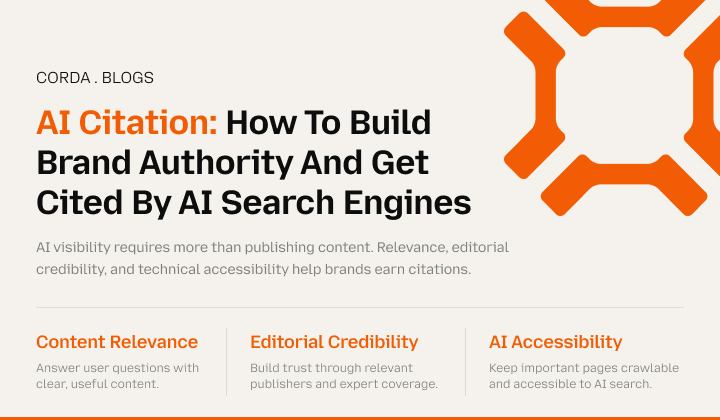
Getting your website to rank on Google is no longer the only visibility challenge. Today, your brand also needs to appear when potential customers ask ChatGPT, Gemini, Perplexity, or Google AI Overviews for recommendations.
However, appearing in an AI-generated answer is not as simple as publishing more blogs or building more backlinks. AI search engines retrieve information, assess relevant sources, and generate answers with supporting citations.
Therefore, brands need to build a stronger presence across their own websites and the wider publishing ecosystem.
The opportunity is significant. A Yext study of 6.8 million AI citations across ChatGPT, Gemini and Perplexity found that 86% came from brand-managed sources, including company websites and listings. This shows why brands should first strengthen the information they control.
At the same time, independent publisher coverage remains an important part of a wider authority strategy.
So, how can your business become a source that AI search engines reference? More importantly, how can you identify the right opportunities and measure your progress?
Let’s explore.
What Is AI Citation?
An AI citation occurs when an AI-powered search platform references an external source to support information in its generated answer. The source may appear as a clickable link, a reference card, or a supporting citation.
For example, imagine someone asks ChatGPT to recommend cybersecurity software for a growing business. The platform generates a response and references three websites to support its recommendations. Those websites have received AI citations.
However, an AI citation is not the same as an AI mention or a traditional backlink.
AI Citations VS. AI Mentions VS. Backlinks
These three terms describe different types of online visibility.
| Term | Meaning |
| AI citation | An AI-generated answer references a website as a source. |
| AI mention | An AI platform names a brand, product, or business. |
| Backlink | Another website links to a page on your website. |
For instance, ChatGPT might mention your company without linking to its website. That is a brand mention, not necessarily a citation.
Similarly, a publisher might link to your website in an article. That creates a backlink, but it doesn’t guarantee an AI platform will reference the page.
Therefore, brands should monitor all three signals instead of treating them as interchangeable.
How Do AI Search Engines Select Websites For Citations?
AI search engines do not simply copy the first few Google results. Instead, platforms can retrieve information from different sources, assess its relevance, and use selected information to generate an answer.
One important approach is Retrieval-Augmented Generation (RAG). It connects language models with external information sources so that generated answers can use relevant retrieved content.
Here is how the process generally works:
- Query interpretation: The AI understands the user’s question and identifies the information needed.
- Information retrieval: The system searches available sources for relevant pages and passages.
- Source evaluation: It assesses the retrieved information for relevance and usefulness.
- Answer generation: The model combines selected information into a response.
- Citation: The platform may display links to sources supporting its answer.
However, each platform uses its own retrieval systems and selection methods. As a result, ChatGPT, Gemini, Perplexity, and Google AI Overviews may reference different websites for similar questions.
A 2026 research paper, What Drives AI Citations? Content, Retrieval and Model Knowledge in GEO, analyzed 158,099 answers and 468,037 citations.
The findings showed that matching page titles and paragraphs to users’ questions improved the likelihood of citations.
Furthermore, its analysis found that search retrieval explained considerably more citation variation than individual page-level properties.
This gives brands an important lesson: content must match what people are searching for, but it must also be discoverable through the retrieval systems AI platforms use.
What Makes A Website Worth Citing In AI Search?
A website does not become a trusted source simply because it has a high Domain Rating or publishes hundreds of articles. Instead, several factors work together.
1. Content Relevance And Search Intent
AI systems need information that answers the user’s actual question. Therefore, brands should create content around specific problems, questions, and industry topics.
For example, a cybersecurity company should cover more than general cybersecurity trends. It should also address endpoint protection, network security, threat detection, and enterprise risk management.
This creates a stronger connection between the brand and its subject area.
2. Original Research And First-Hand Information
Generic content is easy to reproduce. However, original information gives other websites a reason to reference your work.
For this reason, publish:
- Original industry research and surveys.
- First-hand case studies.
- Expert interviews and commentary.
- Proprietary statistics and market comparisons.
- Data-backed industry reports.
These resources can provide information that readers and other publishers cannot easily find elsewhere.
3. Topical Authority
A single article rarely establishes expertise across an entire subject. Instead, brands should publish connected content that covers different aspects of their industry.
For example, a marketing technology company can create related resources on SEO, digital PR, publisher outreach, link building, and AI search.
Moreover, internal links should connect these resources wherever they add value. This helps readers discover related information and makes the website easier to navigate.
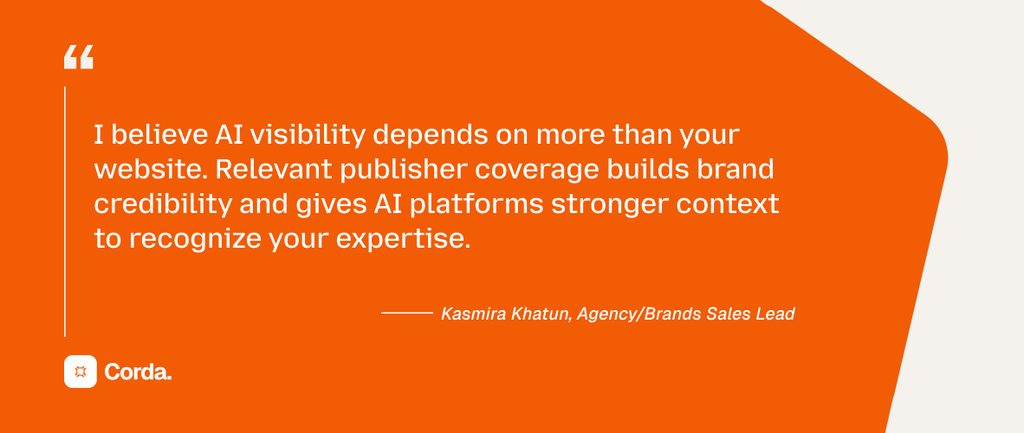
4. External Credibility And Editorial Recognition
Your website is not the only place where AI platforms can find information about your business.
They may also pull information from industry publications, review platforms, news websites, and independent resources. Therefore, relevant third-party coverage can strengthen your brand’s presence across the web.
Focus on publications that:
- Cover your industry regularly.
- Reach an audience relevant to your business.
- Publish credible, well-researched content.
- Provide useful context around your products or expertise.
However, do not chase mentions simply to increase their number. Let relevance and editorial quality guide your publisher selection.
5. Technical Accessibility
Even useful content needs to be accessible to search systems.
Therefore, check whether your important pages are crawlable and indexable. Also, review your robots.txt file, internal links, page structure, and mobile experience.
For ChatGPT search, OpenAI’s publisher guidance specifically recommends allowing OAI-SearchBot to crawl website content.
Similarly, Google’s Search Central documentation confirms that existing SEO fundamentals remain relevant to AI Overviews and AI Mode. It does not require special AI schema or additional technical markup for inclusion.
How To Get Your Website Cited By AI Search Engines
Now that you understand the factors behind AI citations, the next step is to turn them into a practical strategy.
1. Identify The Queries Your Audience Asks AI
Start with the questions your customers ask before choosing a product or service.
For example, a business selling project management software might target:
- What is the best project management software for small teams?
- How can businesses improve team productivity?
- Which project management tools support remote teams?
- What features should businesses compare before buying project management software?
However, do not stop at your primary keywords. AI search systems may break complex questions into smaller related searches, a process often called query fan-out.
Therefore, build content around connected questions and user needs instead of targeting isolated keywords.
2. Create Content That Answers Questions Clearly
A useful page should answer its main question without making readers search through several paragraphs.
Start each section with a direct response. Then, explain the reasoning, add supporting facts, and provide examples.
For instance, if the heading asks how editorial placements help brand authority, explain the relationship immediately. After that, discuss publisher relevance, contextual links, and third-party recognition.
Also, use descriptive headings, accurate statistics, and meaningful examples. These elements make the information easier to understand.
3. Publish Original Research And Data
Original information gives your website a stronger reason to be referenced.
For example, conduct a survey of industry professionals, analyze market trends or publish a case study based on actual campaign results.
Consider Corda’s CapCut campaign as an example of measurable authority-building work.
The campaign recorded:
- Organic traffic grew from 2.2 million to 11.7 million, a 430% increase.
- Referring domains increased from 4,523 to 10,763.
- Organic ranking keywords grew from 400,000 to 4.8 million.
- Organic traffic value increased from $250,474 to $1,077,867.
These results came from a targeted authority campaign involving competitor analysis and relevant contextual publisher placements. They demonstrate organic search growth, not a measured increase in AI citations.
Nevertheless, detailed case studies like this provide concrete information that can support future editorial references.
4. Build Topical Authority Through Relevant Content
Publishing one article on a subject isn’t enough to demonstrate broad expertise.
Instead, develop a connected content strategy. For example, a SaaS brand can cover:
- Industry problems and solutions.
- Product comparisons.
- Practical implementation guides.
- Customer experiences.
- Original industry research.
Furthermore, connect these articles through relevant internal links. This creates a clearer content structure and helps users explore related topics.
5. Earn Relevant Editorial Mentions And Backlinks
Your brand’s authority extends beyond its website. Therefore, building relationships with relevant publishers should be part of your visibility strategy.
However, choosing publishers based only on DA or DR can lead to poor decisions. Evaluate each opportunity using several factors:
- Topical relevance.
- Organic traffic quality.
- Audience alignment.
- Editorial standards.
- Indexing status.
- Content context.
Additionally, prioritize placements that give your brand meaningful exposure over links in unrelated articles.
Remember, backlinks and editorial mentions do not guarantee AI citations.
Still, relevant third-party coverage can improve your broader digital presence and create more opportunities for your brand to be discovered.
6. Strengthen Your Brand And Author Credibility
Readers need to know who created your content and why they should trust it.
Therefore, add clear author profiles, relevant experience, company information and supporting references.
Also, keep brand information consistent across your website and credible external platforms.
When independent publications discuss your business, make sure the information is accurate and relevant. Over time, this helps build a more complete picture of your brand across the web.
7. Make Your Website Accessible To AI Crawlers
Check the technical settings that control access to your content. For example:
- Allow relevant search crawlers through your robots.txt file.
- Keep important pages indexable.
- Use descriptive page titles and headings.
- Maintain a clear internal linking structure.
- Ensure important information is available in text.
- Review server and CDN restrictions.
For Google AI Overviews, normal Google Search eligibility and SEO fundamentals apply. Meanwhile, OpenAI provides separate guidance for OAI-SearchBot.
Therefore, check each platform’s requirements rather than assuming one crawler setting covers every AI search engine.
8. Update Existing Content Regularly
Outdated information can reduce the usefulness of an otherwise strong article.
Review your existing content for expired statistics, old product details, broken references and changes in industry practices.
Moreover, update case studies and comparison pages when new information becomes available.
This keeps your content useful for readers and gives search systems more accurate information to retrieve.
Does Link Building Help You Earn AI Citations?
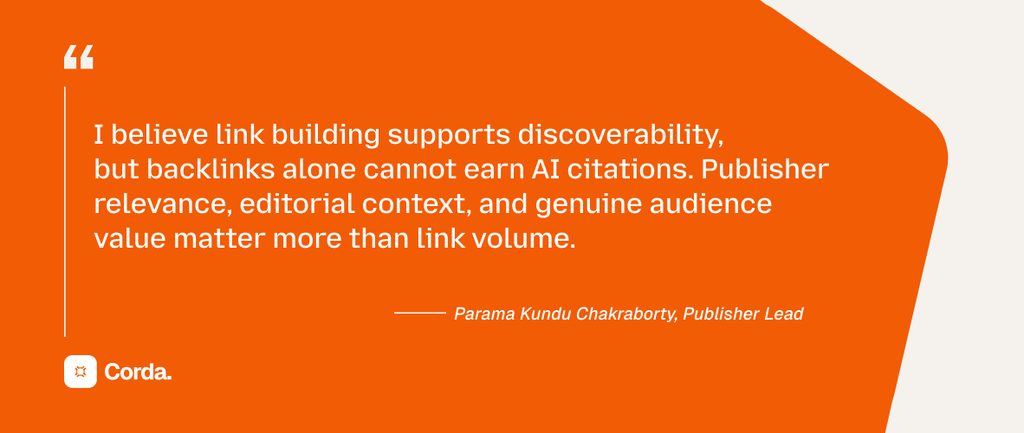
Yes, link building can support the wider authority and discoverability strategy. However, it is important to understand what it can and cannot do.
A backlink can help search engines discover pages and evaluate relationships between websites. Similarly, relevant editorial coverage can introduce your brand to new audiences and provide independent context about your expertise.
However, neither guarantees that ChatGPT, Gemini or Perplexity will cite your website.
The quality of the publisher matters. So does the context in which your brand appears.
For example, a cybersecurity brand featured in a respected cybersecurity publication has a more relevant editorial relationship than the same brand mentioned in an unrelated lifestyle article.
Therefore, focus on:
- Publishers that cover your industry.
- Content that discusses your actual expertise.
- Natural, contextual references.
- Editorial placements with genuine audience value.
- A consistent publishing and outreach strategy.
The objective is not to collect as many backlinks as possible. Instead, build a relevant network of publishers that supports your brand’s authority.
How Corda Helps Brands Build Authority For AI Search
Finding the right publishers is only one part of the process. Brands must also understand their competitors, identify authority gaps, evaluate opportunities, and manage campaigns.
This is where Corda brings the workflow together.
Corda is an AI-powered authority intelligence and campaign platform. It connects competitor analysis, publisher discovery, campaign planning, and performance tracking in one workspace.
Here is how the process works.
1. Discover Authority Gaps Through Competitor Analysis
Start by analyzing your website and comparing it with relevant competitors.
Corda helps identify differences in backlink profiles, publisher coverage, authority signals and search visibility.
As a result, you can understand where competitors have an advantage and which opportunities deserve attention.
2. Find Publishers That Match Your Campaign Goals
A large publisher list does not automatically create a good campaign.
Instead, evaluate opportunities based on relevance, authority, organic traffic, indexing, and other quality signals.
Corda’s publisher discovery workflow uses these factors to help rank potential matches. You can review the available information and select publishers that fit your industry, campaign objectives, and budget.
3. Turn Opportunities Into Campaigns
Once you select publishers, move them into an organized campaign.
Corda helps you manage campaign setup, publisher selection, approvals, placements, and budgets.
Furthermore, AI-assisted recommendations can help with campaign planning. However, you retain control over the final decisions.
4. Track Campaign Progress and Authority Signals
Campaign execution should not end when a publisher accepts an order.
You also need to review publication status, indexing, backlinks, search visibility, and other performance indicators.
Corda brings campaign information and authority insights into one workspace. This helps teams understand what has progressed and where the next opportunity may lie.
Explore how Corda’s authority and campaign platform connects these activities.
For growing businesses, Corda for Brands provides a connected way to review authority gaps, discover publishers, and manage campaigns without first building a full SEO team.
Similarly, agencies can use Corda for Agencies to organize publisher research, client campaigns, approvals, and reporting across multiple projects.
The important distinction is that Corda helps organize and measure authority-building work. It does not guarantee AI citation, rankings, or traffic.
How To Measure AI Citations And Brand Visibility
You cannot improve what you do not measure. Therefore, track more than the number of times an AI platform mentions your business.
Use the following metrics:
| Metric | What to measure |
| AI citations | How often AI answers reference your website. |
| AI brand mentions | How frequently platforms mention your brand. |
| Citation share | Your citations compared with competitors for a defined query set. |
| Cited pages | Which website pages receive AI citations. |
| Referral traffic | Visits coming from AI platforms. |
| Conversions | Leads, sign-ups or sales from AI referrals. |
| Organic visibility | Changes in rankings, keywords, and search traffic. |
You can start by manually testing prompts across ChatGPT, Gemini, and Perplexity. However, use a consistent set of questions so that you can compare results over time.
Also, use Google Search Console and Google Analytics to monitor organic performance and referral visits.
One important point: an AI citation does not always generate a website visit. A user may read the answer without clicking its source. Therefore, measure citations, traffic, and conversions separately.
Common AI Citation Myths Brands Should Stop Believing
Plenty of advice exists about AI search optimization. However, not every recommendation has strong evidence behind it.
Here are five misconceptions worth avoiding.
Myth 1: Ranking first on Google guarantees AI citations.
Fact: Search visibility can help with discovery. However, AI platforms use their own retrieval and citation processes.
Myth 2: More backlinks automatically mean more AI citations.
Fact: Backlinks alone do not determine whether a page will appear in an AI-generated answer.
Myth 3: Publishing more AI-generated articles improves citation frequency.
Fact: Content quality, relevance, and original information matter more than publishing volume.
Myth 4: Adding special AI schema guarantees visibility.
Fact: Google does not require special schema markup for inclusion in AI Overviews or AI Mode.
Myth 5: Brand mentions and AI citations mean the same thing.
Fact: A platform can mention your brand without linking to a supporting source.
Build Authority Before Chasing AI Citations
AI citations create another way for people to discover businesses. However, earning them requires more than adding keywords or publishing more content.
Brands need useful information, relevant publisher coverage, technical accessibility, and a consistent authority-building strategy.
More importantly, they need to understand where competitors are gaining visibility and which opportunities are worth pursuing.
That is why authority building should begin with data, not guesswork. Analyze your competitors, identify the gaps, select relevant publishers, and track the results.
With Corda, you can connect these activities in one workflow. AI can guide the next move. Your team decides where to build authority.