

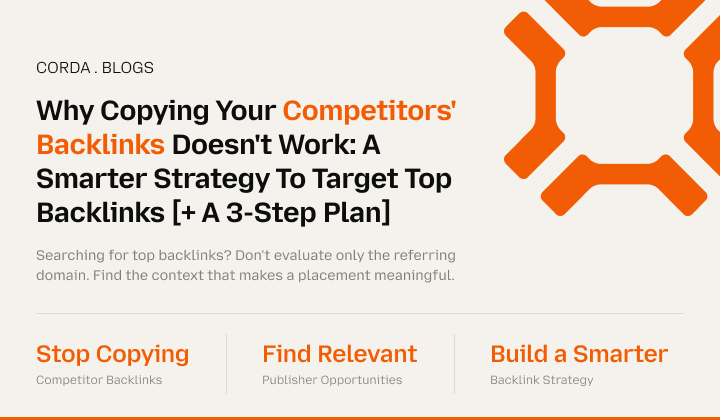
Your Competitor’s Backlink Profile Is Not Your Blueprint. What if that guy has 500 referring domains? And you have 150? Should you acquire the same backlinks to close the gap? Not necessarily.
Trying to build the top backlinks by copying competitor profiles often creates a collection of links without addressing the authority gaps holding your website back.
A publisher that benefits one business may be irrelevant to another, while valuable opportunities outside your competitors’ networks remain undiscovered.
The smarter approach is to understand why competitors earn links, identify where your website lacks relevant publisher coverage, and build a backlink profile around your own business objectives.
This requires moving beyond backlink replication towards competitor gap analysis, strategic publisher discovery, and client-specific campaign planning.
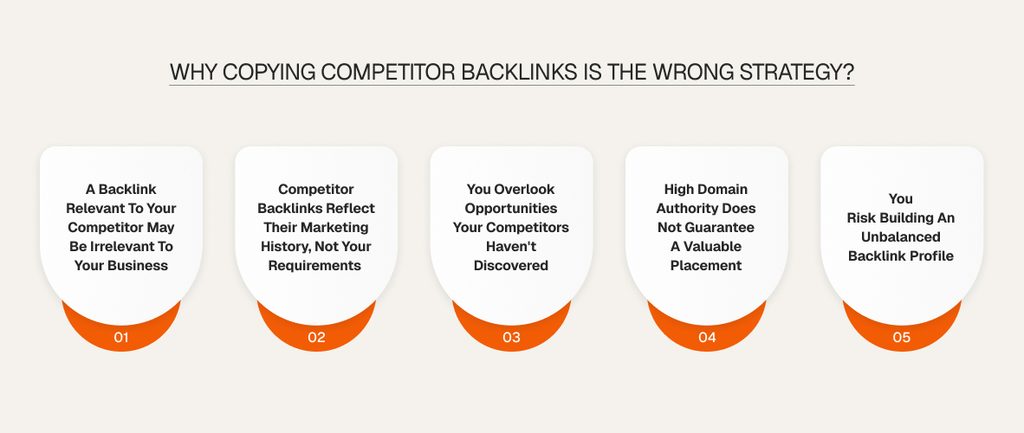
Why Copying Competitor Backlinks Is The Wrong Strategy?
Competitor backlink analysis is an important part of SEO. It reveals which websites reference competing brands, what content attracts external links, and where competitors have established industry visibility.
However, there is a fundamental difference between using this information as intelligence and treating it as an acquisition checklist.
Here are five reasons why copying competitor backlinks can undermine your strategy.
A Backlink Relevant To Your Competitor May Be Irrelevant To Your Business
Consider two technology companies:
- Company A provides enterprise cybersecurity software.
- Company B develops cloud infrastructure solutions.
Both compete for visibility across the technology sector. Both might have backlinks from business publications, technology magazines, and enterprise IT websites.
However, a cybersecurity publication referencing Company A’s threat detection capabilities may have little reason to link to Company B’s cloud infrastructure services.
The domain might have impressive authority metrics, but that does not automatically make the placement relevant.
A useful backlink evaluation considers five dimensions:
- Domain relevance: Does the publisher cover subjects connected to your industry?
- Page relevance: Does the specific article relate to your business or expertise?
- Contextual relevance: Does the link fit naturally within the discussion?
- Destination relevance: Does your target page provide something valuable to readers?
- Audience relevance: Does the publisher reach the people your business wants to influence?
When planning for top backlinks, don’t evaluate only the referring domain. By doing so, you overlook the context that makes a placement meaningful.
Competitor Backlinks Reflect Their Marketing History, Not Your Requirements
A competitor’s backlink profile is the accumulated result of its marketing activities, partnerships, public relations, content production, and industry relationships.
Some links might have originated from:
- Product launches covered by industry publications.
- Original research cited by journalists.
- Expert interviews and founder contributions.
- Business partnerships and sponsorships.
- Guest contributions and thought leadership.
- Industry events and professional associations.
These links were not necessarily acquired through a deliberate strategy to improve rankings for particular keywords.
For example, a publisher might have linked to your competitor because it published an exclusive industry report. Sending that publisher a generic guest-post proposal does not recreate the circumstances behind the original link.
You need to understand why the competitor received the reference before deciding whether the publisher represents an opportunity for your business.
You Overlook Opportunities Your Competitors Haven’t Discovered
Suppose five competitors have backlinks from the same 30 technology publications.
A conventional approach would prioritize those 30 websites because they represent proven competitor placements.
But what about specialist publications that cover your industry without linking to any of those competitors?
What about emerging niche websites, professional resources, regional publications, and industry-specific platforms?
These could offer equally interesting, or even more relevant, opportunities.
Competitor backlink replication creates a restricted view of the publisher ecosystem. It encourages businesses to compete for existing opportunities rather than discover new ones.
Your competitors’ referring domains reveal where they have established a presence. They do not define the boundaries of your publisher discovery strategy.
High Domain Authority Does Not Guarantee A Valuable Placement
Another common mistake is treating Domain Authority (DA) or Domain Rating (DR) as the primary measure of backlink quality.
Consider these hypothetical publishers:
| Publisher | DA | Topical relevance | Audience fit |
| General business portal | 85 | Low | Moderate |
| Specialist technology publication | 55 | High | High |
| Industry research website | 48 | High | High |
The general business portal has the highest DA. However, the specialist publication may offer a stronger contextual relationship with the business.
Other factors matter:
- Does the website attract genuine organic traffic?
- Does it publish useful, original content?
- Are relevant articles indexed?
- Does it have excessive outbound links?
- Are external references editorially appropriate?
- Does its audience match your target market?
Authority metrics provide context, not a complete assessment of publisher suitability.
You Risk Building An Unbalanced Backlink Profile
Suppose a competitor has acquired most of its backlinks through guest contributions.
Replicating that pattern without evaluating your existing backlink profile could make your own acquisition strategy excessively dependent on one placement type.
Your business might benefit from a broader combination of relevant editorial references, industry research citations, expert contributions, digital PR, partnerships, and useful resource-page mentions.
There is no universal ideal distribution. The appropriate mix depends on your industry, existing authority, campaign objectives, and available opportunities.
The objective should be to build the backlink profile your business needs, not to reproduce another website’s acquisition history.
The Better Alternative: Use Competitor Gap Analysis To Build Your Strategy
If copying competitor backlinks is ineffective, what should businesses do instead?
Turn competitor intelligence into a customized authority-building strategy. This involves five interconnected stages:
- Establish your website’s existing authority position.
- Identify relevant competitor backlink gaps.
- Discover publishers beyond competitor referring domains.
- Build a client-specific publisher and placement strategy.
- Execute campaigns and measure progress against the original gaps.
Each stage informs the next. You are not simply collecting websites; you are identifying where your business needs stronger external recognition and determining how to achieve it.
Step One: Establish Your Website’s Authority Baseline
Before analyzing competitors, understand your own backlink profile.
Start by examining four areas.
Existing referring domains: Which websites currently link to you? Are they concentrated in one industry or publisher category?
Target pages: Are your backlinks primarily pointing to your homepage, or do important product, service, and informational pages also receive external references?
Keyword priorities: Which commercial and informational search terms are connected to your business objectives?
Authority requirements: Are you trying to strengthen product-category visibility, establish expertise in a new market, or improve your representation across a particular industry?
For example, a SaaS company might have a relatively strong homepage backlink profile but limited external references to its product and integration pages.
Its priority may therefore be page-level authority rather than simply acquiring more referring domains.
This baseline becomes the reference point for subsequent competitor analysis.
Step Two: Identify Competitor Backlink Gaps, Not Just Missing Links
This is where competitor research becomes genuinely valuable.
Instead of exporting every competitor backlink and approaching the same publishers, compare backlink ecosystems to understand meaningful differences.
Select two to four competitors that share similar customers, topics, search opportunities or markets.
Then investigate three types of gaps.
A. Publisher Gaps
These are publications that link to relevant competitors but do not reference your website.
For example, if three competing cybersecurity companies receive editorial coverage from specialist IT security publications, but your brand has little representation in that category, you may have an opportunity to strengthen your presence.
However, a missing link does not automatically justify a placement.
Ask whether the publisher covers your subject, reaches your intended audience and has a credible reason to reference your business.
B. Page-Level Gaps
Examine which competitor pages attract external references.
For instance:
- A competitor’s product page receives links from software publications.
- Its original research attracts industry citations.
- Professional websites reference its educational resources.
If your equivalent pages lack external support, investigate why.
You may discover that your competitor has published more useful resources, developed stronger product documentation, or created original research worth referencing.
Sometimes the appropriate next step is improving your content before pursuing placements.
C. Topical Authority Gaps
Your competitors might have established strong visibility across cybersecurity, enterprise software, and IT infrastructure publications.
Meanwhile, your backlinks may be concentrated around general business websites.
The problem is not necessarily the total number of backlinks. It could be limited representation across the topics that matter to your business.
Identifying these patterns helps determine which publisher categories deserve attention.
How Should You Prioritize Competitor Gaps?
Evaluate each opportunity against the following criteria:
| Evaluation factor | What to investigate |
| Business relevance | Does it support a commercial priority? |
| Topical relevance | Is the publisher connected to your subject? |
| Competitor evidence | Is the gap supported by meaningful competitor activity? |
| Page relevance | Do you have an appropriate destination page? |
| Editorial feasibility | Is there a legitimate reason for a reference? |
| Audience value | Does the publication reach your intended audience? |
A publication linking to four competitors might look attractive, but a specialist website that has never linked to them could be a better opportunity.
This is the difference between copying competitor backlinks and doing strategic gap analysis.
Step Three: Discover Publishers Beyond Competitor Referring Domains
Once you understand the gaps, expand your publisher discovery process. Three sources of opportunities are useful.
- Competitor-associated publishers: Websites that already cover your competitors or their industry. These show relevant subject coverage, though individual opportunities still need evaluation.
- Topic-based publishers: Publications that regularly discuss your target topics, even if they have never linked to your competitors.
- Audience-based publishers: Websites that reach your target decision-makers, even when their primary subject is broader than your product category.
Consider a financial technology company targeting CFOs.
Its potential publisher ecosystem could include finance magazines, business news websites, fintech platforms, enterprise technology publications, and professional financial resources.
The common factor is audience relevance, not simply competitor overlap.
Evaluate publishers before selecting placements
A useful publisher evaluation framework should include:
| Factor | What to assess |
| Topical fit | Connection with your industry |
| Authority | DA, DR, and other available metrics |
| Organic visibility | Estimated traffic and search presence |
| Editorial quality | Originality and publication standards |
| Indexing | Indexation of relevant pages |
| Audience fit | Alignment with your intended readers |
| Outbound links | Quality and patterns of external references |
| Destination fit | Suitability of your proposed target page |
No single metric should determine publisher selection.
The objective of building the top backlinks is not to accumulate placements on websites with impressive numbers.
It is to establish relevant, credible connections between your business and the wider publisher ecosystem.
Step Four: Build A Backlink Profile Around Your Business Requirements
This is arguably the most important stage.
After identifying competitor gaps and discovering potential publishers, determine what your final backlink profile should look like.
A customized strategy should answer five questions:
- Which pages need external support?
- Which topics should your brand be associated with?
- Which publisher categories can establish those associations?
- What placement mix makes sense?
- How should the strategy evolve over time?
Consider three businesses:
| Client | Authority objective | Relevant publisher categories |
| Cybersecurity company | Industry credibility | Security publications, IT research websites, enterprise technology portals |
| B2B SaaS company | Product and category visibility | SaaS publications, software resources, business technology websites |
| Financial services company | Market and audience relevance | Finance publications, fintech platforms, business news websites |
All three may have competitors receiving links from major business publications.
However, their ideal backlink profiles will differ.
Even two businesses in the same industry may require different strategies because of their existing authority, target keywords, geographical markets, landing pages, and budgets.
Build The Right Placement Mix
A campaign should not revolve around an arbitrary target of 50, 100, or 200 backlinks.
Instead, determine the publisher mix according to the authority gaps identified.
For example, a B2B technology company might prioritize:
- Specialist technology publications for topical relevance.
- Enterprise business publications for decision-maker visibility.
- Industry-specific websites for subject-area representation.
- Research platforms for informational citations.
- Relevant digital PR outlets for broader brand visibility.
Determine the proportions based on campaign requirements, not a universal formula.
Also distinguish between earned editorial references and paid placements. Paid placements should be transparent and appropriately qualified under applicable search-engine guidelines.
Purchasing a placement does not automatically make it an independent editorial endorsement.
Match Placements With Target Pages
Do not send every backlink to your homepage.
A more strategic approach connects publishers with appropriate destinations:
| Campaign objective | Potential destination |
| Strengthen product visibility | Product page |
| Establish industry expertise | Research or resource page |
| Support commercial services | Service landing page |
| Promote a new solution | Product or campaign page |
| Demonstrate thought leadership | Original research or expert content |
The publisher, article topic, contextual reference, and destination page should make sense together.
How Corda.marketing Turns Competitor Intelligence Into A Backlink Strategy
The biggest challenge in implementing this approach is execution.
Agencies and in-house SEO teams often need to compare multiple competitors, review thousands of referring domains, assess publishers, organize approvals, and coordinate placements.
When these activities happen across disconnected tools and spreadsheets, valuable research becomes difficult to translate into consistent campaigns.
This is where Corda.marketing becomes relevant.
Corda is an AI-powered authority platform that connects competitor intelligence, publisher discovery, publisher evaluation, campaign planning and placement tracking.
Its purpose is not to reproduce competitor backlink profiles. It helps teams identify authority gaps and turn those findings into client-specific campaigns.
Competitor Intelligence: Understand Where Your Authority Is Missing
Corda’s Competitor Intelligence compares websites across authority, rankings, backlinks and publisher coverage.
It helps identify:
- Which publishers reference competitors but not your website.
- Where competitors have stronger publisher representation.
- Which pages attract external references.
- Which authority gaps deserve further investigation.
The important distinction is that not every missing competitor backlink becomes a recommendation.
A competitor may have a link from an old news article, a sponsorship page, or an unrelated directory. Such links may not address your campaign objective.
Corda’s analysis provides the starting intelligence. Then evaluate the findings against your target page, subject, market, and business goals.
Read more about using competitor intelligence in Corda.
Opportunity Discovery: Find Publishers That Fit Your Campaign
Corda’s AI Publisher Discovery helps teams discover opportunities beyond existing competitor referring domains.
Its platform provides access to more than 17,000 active publishers and ranks potential opportunities using relevance, authority, traffic, and topical fit.
Available publisher evaluation signals include:
- Domain Authority and Domain Rating.
- Estimated organic traffic.
- AI Match Score.
- Indexing status.
- Domain age.
- Editorial quality.
Suppose a client wants to establish stronger visibility in enterprise cybersecurity.
Instead of prioritizing websites solely for high DA scores, the team can investigate publications covering enterprise security, IT infrastructure, threat detection, and related business challenges.
This aligns publisher discovery more closely with the client’s requirements.
Publisher Intelligence: Evaluate Quality Before Selecting Placements
A publisher’s authority score alone cannot establish its suitability.
Corda’s Publisher Intelligence brings multiple evaluation signals together so teams can assess the website before committing to a placement.
The objective is to identify whether a publisher has relevant subject coverage, suitable editorial standards, meaningful search visibility, and a credible connection to the campaign.
Corda’s AI provides recommendations, but the user retains control. Teams can review, remove, replace, or manually select publishers.
This human oversight is important because contextual suitability still requires judgment.
AI-Based PR Strategy: Turn Opportunities Into A Campaign
Once publishers have been identified, Corda’s AI-based PR Strategy helps translate the findings into campaign recommendations. The planning process connects:
- Authority goals
- Identified authority gaps
- Target pages and topics
- Publisher opportunities
- Placement mix
- Budget requirements
- Execution rationale
For example, an enterprise software company might develop two separate campaigns.
Campaign A: Product-Page Authority
Prioritize relevant software and enterprise technology publications that can provide contextual coverage for a priority product page.
Campaign B: Industry Visibility
Identify specialist publications and industry resources that can strengthen the brand’s presence across its wider subject area.
Both campaigns serve the same client but address different authority requirements.
Campaign Execution And Tracking: Connect Strategy With Outcomes
Corda brings campaign creation, approvals, publishing and placement tracking into a connected workspace.
Its Wallet and Budget Ledger support spending visibility and placement-related tracking, while the Live Authority Graph helps teams monitor placements, indexing and backlink growth.
For agencies, separate client workspaces help organize different objectives, publisher requirements, budgets, and campaign progress.
The workflow becomes:
Analyze → Identify Gaps → Discover Publishers → Evaluate → Build Campaigns → Execute → Measure → Reassess
Instead of maintaining disconnected research documents and placement trackers, teams can manage the process through one platform.
What Strategic Backlink Building Looks Like In Practice: The CapCut Case Study
Corda’s published CapCut case study demonstrates how competitor intelligence and publisher relevance can inform a larger authority strategy.
CapCut’s objective was to expand organic visibility and reach new markets. Corda began by comparing its backlink ecosystem against competitors to identify authority gaps and relevant publisher opportunities.
The campaign then connected keyword opportunities, target pages, publisher selection, and contextual placements.
The reported outcomes included:
| Performance indicator | Before | After |
| Organic traffic | 2.2 million | 11.7 million |
| Referring domains | 4,523 | 10,763 |
| Ranking keywords | 400,000 | 4.8 million |
| Organic traffic value | $250,474 | $1,077,867 |
These represent reported campaign-period changes: 430% organic traffic growth, 237% referring-domain growth, 1,100% ranking keyword growth, and 330% organic traffic value growth.
The case study also describes publisher selection criteria of DA 40+ and at least 10,000 monthly organic visitors.
The key lesson is that acquiring more referring domains doesn’t automatically drive traffic growth.
Competitor intelligence becomes more actionable when connected to keyword opportunities, relevant publishers, and the right target pages.
The results are specific to this campaign and should not be treated as guaranteed outcomes for other businesses.
Measure Whether Your Backlink Strategy Is Addressing The Right Gaps
A campaign that acquires 50 backlinks is not necessarily successful.
The real question is whether those placements address the authority requirements identified at the beginning.
Monitor six areas:
| Metric | What it tells you |
| New referring domains | Growth in external references |
| Publisher relevance | Quality of industry representation |
| Target-page links | External support for priority pages |
| Keyword visibility | Changes in search presence |
| Organic traffic | Whether visibility translates into visits |
| Referral traffic | Whether placements attract visitors |
Also monitor indexing, anchor-text distribution, publisher quality, and the diversity of referring domains.
Most importantly, compare the results with the original campaign objective.
If the campaign was designed to improve enterprise software publisher coverage, did you actually establish relevant relationships in that category?
If it was designed to strengthen a product page, did that page receive the intended contextual references?
Corda’s campaign tracking and Live Authority Graph help connect campaign activity with authority signals and progress.
Remember that rankings, traffic, and conversions depend on several factors beyond backlinks.
Start Building Your Own Authority Today (3-Step Plan)
Competitor backlink analysis should inform your decisions, not dictate them. The most effective approach to creating top backlinks includes these steps:
- understanding your own authority gaps
- identifying relevant publisher opportunities
- developing a profile that reflects your business requirements
Instead of chasing the same domains as your competitors, discover publications that can establish your expertise, strengthen your topical relevance, and reach your intended audience.
That is the shift from backlink replication to strategic authority building.
Corda brings competitor intelligence, AI-powered publisher discovery, publisher evaluation, campaign planning, and tracking into one connected platform, helping businesses and agencies turn research into actionable campaigns.
The question is no longer simply, “Where are my competitors getting backlinks?”
The ideal query would be: “Which publishers should recognize our brand, which authority gaps should we address, and what is the right strategy to get there?”
Build a backlink profile around your own goals. Discover opportunities your competitors may have overlooked. And make every placement part of a larger authority strategy.
Explore Corda to learn how to build your next authority campaign with intelligence, relevance, and purpose.