

For years, Domain Authority (DA) has been one of the most frequently referenced numbers in SEO.
Businesses use it to evaluate competitors, agencies use it to assess websites for link-building opportunities, and marketers often treat a rising DA score as evidence of SEO progress.
But there is a problem: a website can have a high Domain Authority and still lack the topical relevance, brand recognition, content credibility, and search visibility required to compete in modern search.
This distinction is becoming increasingly important as search evolves in 2027. Google evaluates individual pages through multiple ranking systems.
However, AI-powered search experiences increasingly introduce users to information through generated answers and citations. A strong backlink profile alone cannot establish all these forms of credibility.
The solution is to measure SEO authority as a combination of seven interconnected dimensions: link authority, topical authority, page authority, content authority, brand authority, technical authority, and AI visibility.
What Is SEO Authority In 2027?
In 2027, SEO authority is a more complete way to assess whether your website is recognized, discoverable, useful, and credible within its industry.
This shift is already visible in industry data.
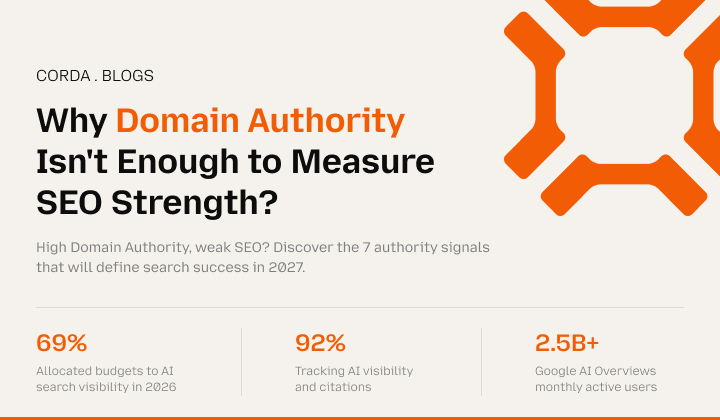
The 2026 SEOFOMO State of AI Search Optimization survey, covering 171 search professionals across 36 countries, found that 69% had allocated budgets to AI search visibility, compared with 38% in 2025.
Furthermore, 92% were tracking AI visibility and citations. The industry is beginning to measure visibility beyond conventional rankings.
The question for businesses is no longer simply how to increase DA. It is how to build a website that deserves to be found, referenced, and trusted.
1. Domain Authority VS. SEO Authority: What Is the Difference?
Before exploring the solution, it is important to understand what Domain Authority actually measures.
Domain Authority is a proprietary metric developed by Moz. It predicts a website’s relative ability to rank in search results, using a 1–100 scale. It is calculated using signals associated primarily with the website’s backlink profile.
Similar metrics include Ahrefs’ Domain Rating (DR) and Semrush’s Authority Score. Although their methodologies differ, they are third-party indicators, not scores assigned by Google.
For example, Semrush’s Authority Score combines link power, estimated organic traffic, and spam-related indicators. Ahrefs DR primarily evaluates the relative strength of a site’s backlink profile.
So, does Domain Authority help organic SEO? Yes. It provides a useful comparative indicator when evaluating backlink strength and potential link-building opportunities. But it cannot independently establish whether a website is a credible resource for a particular subject.
A Hypothetical Scenario
- Website A has a DA of 75, hundreds of referring domains and backlinks from multiple industries, but publishes inconsistent content across unrelated subjects.
- Website B has a DA of 38, but publishes original research in one industry, earns relevant editorial mentions, has recognized subject-matter experts, and consistently ranks for commercially valuable queries.
Website A has the stronger third-party domain metric. Website B may have stronger SEO authority within its specialist subject.
This is the difference marketers need to understand.
| Comparison | Domain Authority | SEO Authority |
| Meaning | Relative domain-level link strength and ranking prediction | Broader assessment of search credibility and visibility |
| Measurement | Third-party proprietary score | Multiple performance and credibility indicators |
| Backlinks | Primary consideration | One of several dimensions |
| Content quality | Not comprehensively measured | Evaluated through originality, usefulness, and expertise |
| Topical relevance | Limited representation | Central consideration |
| Brand recognition | Not directly measured | Evaluated through branded demand and external recognition |
| AI search | Not a direct measurement | Includes citations, mentions, and source visibility |
| Business outcomes | Does not measure conversions | Can incorporate qualified traffic and conversions |
The important distinction is that Domain Authority is one input into a broader SEO assessment, not a substitute for it.
Why Google Does Not Use Your DA Score
Google does not use Moz’s DA, Ahrefs’ DR, or Semrush’s Authority Score as official ranking factors.
Google’s own documentation explains that its ranking systems consider multiple signals and systems, often working at the page level. Strong site-wide signals do not guarantee that every page will rank highly.
This also explains why a high-DA website can have poorly performing pages: domain-level link strength cannot compensate for every weakness in relevance, content quality, indexing, or search intent.
2. The Seven Dimensions Of SEO Authority You Should Measure In 2027
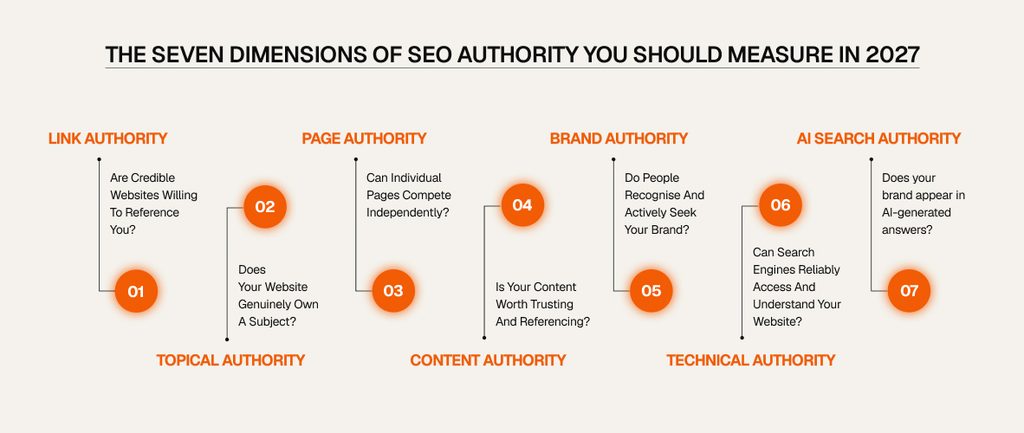
A stronger SEO strategy starts by identifying what kind of authority a website has established and where it still needs improvement.
The following seven-layer framework provides a practical way to do that.
1. Link Authority: Are Credible Websites Willing To Reference You?
(The traditional DA component)
Link authority measures the strength, relevance, and credibility of external websites linking to your domain and individual pages.
Backlinks remain important because Google uses links to discover pages and understand their relevance.
However, the value of a backlink depends on its context, relevance, and quality, not simply the DA or DR of its source.
Why Build It?
Relevant editorial links can strengthen your backlink profile, help search engines discover content, and connect your website to credible industry sources.
Example: The New York Times and Harvard Business Review are examples of established publishers whose relevant editorial references can provide meaningful third-party recognition.
Their value isn’t just a numerical authority score; it also comes from editorial credibility and subject relevance.
How To Build Link Authority:
- Publish original research, surveys, industry reports, and useful statistics.
- Identify publications that regularly cover your industry.
- Offer journalists and editors genuinely useful data or expert commentary.
- Create resources that other websites would naturally want to reference.
- Reclaim unlinked brand mentions where appropriate.
- Review referring domains for relevance, quality, and suspicious patterns.
Metrics to monitor: Referring domains, relevant referring domains, quality editorial backlinks, new and lost links, link growth, and referring-page relevance.
Beginner tip: Ten relevant editorial mentions can be more valuable to your long-term strategy than hundreds of unrelated directory links.
2. Topical Authority: Does Your Website Genuinely Own A Subject?
(A major 2027 priority)
Topical authority refers to the depth and consistency with which a website covers a particular subject and its related questions.
A website that publishes one article about digital marketing is not necessarily an authority on digital marketing.
A website that comprehensively covers technical SEO, keyword research, content strategy, quality link building, analytics, and industry developments has a stronger case for demonstrating subject expertise.
This is why understanding how to build topical authority in SEO should be central to your content strategy.
Why Build It?
Topical depth helps search engines understand the relationship between your pages and the subjects you cover. It also gives readers a reason to return to your website instead of relying on isolated articles.
Example: HubSpot has extensively used pillar pages and topic clusters to organize educational content around marketing, sales, and related subjects.
Its approach connects broad subject pages with more specific supporting resources.
How To Build Topical Authority:
- Select three to five core subjects directly connected to your business.
- Identify the questions, subtopics, and search intents within each subject.
- Create one comprehensive pillar page for each core subject.
- Publish supporting articles addressing individual questions and use cases.
- Link supporting pages to the pillar page and relevant related articles.
- Update older content with new research, examples, and developments.
- Remove duplication and consolidate pages competing for the same intent.
For example, a website targeting SEO authority could organize its content like this:
Pillar Page: SEO Authority
- Comprehensive guide to establishing search credibility
- Domain Authority explained
- How to build topical authority
- Brand authority in SEO
- Building editorial backlinks
- Content quality and E-E-A-T
- AI search visibility
- Technical SEO and indexing
- Measuring organic performance
This is an example of an illustrative pillar-and-cluster structure. Every supporting article should link to the pillar where relevant, with contextual cross-links between related articles.
Metrics to monitor: Non-branded keyword coverage, topic-level impressions, SEO ranking distribution, number of relevant queries, organic clicks across clusters and internal-link coverage.
3. Page Authority: Can Individual Pages Compete Independently?
Page Authority is a proprietary Moz metric that predicts an individual URL’s ranking potential. It is different from Domain Authority, which evaluates the domain as a whole.
Page-level SEO authority is about whether a specific page has the relevance, content depth, backlinks, internal-link support, and technical accessibility to compete for its target queries.
Why Build It?
Search engines often rank individual pages rather than entire websites. A website can have a strong domain profile but still have weak product pages, outdated blog posts or poorly structured landing pages.
Example: Investopedia illustrates the value of building detailed, subject-specific financial education pages. Individual resources need to answer their own queries, not simply inherit the domain’s reputation.
How To Build Page Authority:
- Assign one clear primary search intent to each important page
- Create comprehensive, original content that addresses that intent
- Add relevant internal links from established pages
- Earn external references to important resources
- Improve titles, headings, descriptive URLs and supporting media
- Regularly update pages where information changes
Metrics to monitor: Page-level clicks, impressions, CTR, average position, referring domains, conversions and engagement with the page.
4. Content Authority: Is Your Content Worth Trusting And Referencing?
Content authority is established when a website consistently publishes accurate, useful, original and demonstrably knowledgeable information.
This is where Google’s E-E-A-T framework becomes relevant: Experience, Expertise, Authoritativeness and Trustworthiness.
Importantly, Google explicitly clarifies that E-E-A-T is not itself a single ranking factor. Rather, its systems use a variety of signals to identify helpful, reliable information. Trust is the most important element within the framework.
Why Build It?
Generic content is easy to reproduce. Original analysis, real-world experience, credible sources and expert perspectives give your website a stronger reason to be trusted and referenced.
Example: Mayo Clinic demonstrates how clearly attributed medical expertise, evidence-based information and institutional credibility can support content trust, particularly in a high-stakes subject area.
How To Build Content Authority:
- Add identifiable authors with relevant professional experience.
- Include primary research, proprietary data and real examples.
- Cite authoritative external sources for factual claims.
- Include expert reviews where the subject requires specialist knowledge.
- Update statistics and remove outdated information.
- Explain research methodology and content creation processes when relevant.
- Avoid publishing large volumes of repetitive, low-value AI-generated articles.
Metrics to monitor: Organic visibility of expert-led content, external editorial references, returning readers, content-assisted conversions and engagement with high-value resources.
5. Brand Authority: Do People Recognise And Actively Seek Your Brand?
(Often overlooked in traditional SEO reporting)
Brand authority refers to the recognition, credibility and reputation your organisation establishes within its industry.
A brand people actively search for, mention in industry discussions, and recommend to others has built a different kind of authority than a website that receives traffic only through generic keywords.
Why Build It?
Brand recognition can create demand beyond non-branded search. It can also increase the likelihood that people consider your organisation when researching products, services or industry information.
Google introduced a branded-query filter in Search Console, enabling eligible websites to distinguish branded and non-branded search performance. This makes brand-related search demand more practical to monitor.
Example: Salesforce has built extensive recognition in the CRM and enterprise software market through its products, educational resources, events and industry presence.
How To Build Brand Authority For SEO:
- Develop a recognisable positioning around a specific industry or subject.
- Publish original research under your brand.
- Build relationships with respected industry publications.
- Participate in podcasts, webinars, conferences and professional communities.
- Develop consistent brand messaging across your website and external platforms.
- Encourage genuine customer reviews, testimonials and independent mentions.
Metrics to monitor: Branded search impressions and clicks, branded query growth, direct traffic trends, brand mentions, review quality and referral traffic.
6. Technical Authority: Can Search Engines Reliably Access And Understand Your Website?
Technical authority is a practical framework for assessing whether your website provides the technical foundations required for search visibility.
A website may have excellent content and a strong backlink profile. But if search engines can’t crawl, index, or render important pages correctly, its SEO performance will suffer.
Why Build It?
Technical accessibility ensures that search engines can discover your content and interpret the relationships between your pages.
Example: Wikipedia demonstrates how structured information, consistent page relationships and extensive internal linking help users navigate a large knowledge resource.
How To Build Technical Authority:
- Check indexability and crawlability using Google Search Console.
- Submit an accurate XML sitemap.
- Fix broken internal links and redirect chains.
- Implement appropriate canonical tags.
- Improve mobile usability and page loading performance.
- Use structured data where it accurately describes visible page content.
- Ensure important content is available in crawlable HTML text.
Metrics to monitor: Indexed versus submitted pages, crawl errors, Core Web Vitals, page experience, broken links, sitemap health and structured-data errors.
7. AI Search Authority: Does your brand appear in AI-generated answers?
(The emerging authority dimension)
AI search authority refers to your brand’s visibility and citation presence in generative search experiences such as Google AI Overviews, Google AI Mode, ChatGPT and Perplexity.
It is not an official ranking score or a recognised standalone Google metric. It is a useful way to evaluate whether your website and brand are being discovered, referenced and recommended in AI-assisted research.
Why Build It?
Search discovery is expanding beyond traditional blue links. People increasingly ask AI systems to compare providers, explain complex subjects and recommend solutions.
Google’s June 2026 update reported that AI Overviews had more than 2.5 billion monthly active users and AI Mode had surpassed one billion monthly users. These figures demonstrate the scale of AI-assisted discovery, although they should not be interpreted as website referral traffic.
Example: NerdWallet illustrates a content-led model built around financial comparisons, explanatory resources and editorial credibility. These assets can earn independent references and become useful sources during AI-assisted research.
How To Build AI Search Authority:
- Publish clear, factually accurate answers to specific industry questions.
- Include original data, definitions, comparisons and practical examples.
- Make authorship and organisational identity transparent.
- Earn relevant editorial coverage and third-party mentions.
- Structure content with descriptive headings and logical internal links.
- Keep important information accessible to search crawlers.
- Track brand mentions and citations across multiple AI platforms.
Metrics to monitor: AI citations, brand mentions, share of voice in AI responses, source-page citations, referral sessions and assisted conversions.
Google’s guidance is particularly important here: its AI Search features rely on existing Search systems, and no special technical requirements or mandatory AI-specific schema are needed to appear in AI Overviews or AI Mode. The fundamentals of SEO remain relevant.
3. The 2027 SEO Authority Measurement Scorecard: What Should You Actually Track?
The seven dimensions provide a framework for building authority. But how do you measure whether the strategy is working?
Use a combination of first-party performance data, third-party SEO tools, and AI visibility monitoring.
| Authority dimension | What to measure | Recommended tools |
| Link | Relevant referring domains, editorial links | Ahrefs, Semrush, Moz |
| Topical | Topic coverage, non-branded keyword growth | Google Search Console, Semrush |
| Page | URL-level rankings, clicks, impressions | Search Console, Ahrefs |
| Content | Originality, expert authorship, content performance | Editorial audits, Search Console |
| Brand | Branded queries, mentions, branded clicks | Search Console, Google Trends, media monitoring |
| Technical | Indexing, crawlability, Core Web Vitals | Search Console, PageSpeed Insights, Screaming Frog |
| AI search | Citations, mentions, source visibility | Manual prompt tracking, AI visibility platforms |
The Most Important Metrics To Use In 2027
1. Organic clicks and impressions
These indicate whether your website is gaining visibility and attracting search users. Google Search Console provides both metrics, along with CTR and average position.
2. Non-branded keyword growth
This is particularly important because it measures discovery among people who were not already searching for your brand.
3. Branded search demand
Track branded impressions and clicks separately. An increase can indicate growing recognition, but it does not prove SEO alone caused it.
4. Relevant referring domains
Evaluate the number and quality of independent websites linking to you. Avoid using DA or DR as the only quality filter.
5. Topic-level organic performance
Assess whether a group of related pages is gaining visibility, not just whether individual articles rank.
6. AI citation frequency and share of voice
Monitor how often your brand and URLs appear in relevant AI-generated answers. Track each platform separately because their answers and sources can differ.
7. Organic conversions and revenue
Ultimately, a website should generate business value. Track qualified leads, purchases, enquiries and assisted conversions from organic discovery.
How To Check The Authority Score Of A Site For SEO?
There is no universal SEO authority score. However, you can use the following tools to assess different parts of the picture.
- Moz Link Explorer: Check Domain Authority and Page Authority.
- Ahrefs Website Authority Checker: Evaluate Domain Rating and backlink profiles.
- Semrush: Check Authority Score, estimated organic traffic and referring domains.
- Small SEO Tools: Its bulk domain authority checker can help beginners compare several domains using third-party metrics.
Use these tools as diagnostic resources, not as substitutes for Google Search Console data.
A useful reporting rule: Never report an increase in DA as proof of improved SEO authority unless you can also demonstrate growth in relevant search visibility, topical performance, brand recognition or other meaningful outcomes.
4. What Actually Influences SEO Authority in 2027?
Building SEO authority requires more than publishing frequently or acquiring backlinks. Several interconnected factors determine whether your website develops a credible presence in its industry.
| Factor | Why it matters | What to prioritize |
| Content originality | Differentiates your information from competing resources | Original research and analysis |
| Subject relevance | Establishes a consistent area of expertise | Topic clusters and content depth |
| Backlink relevance | Connects your website with credible external sources | Editorial links from relevant publishers |
| Brand recognition | Builds demand beyond generic search queries | Consistent brand presence and mentions |
| Author credibility | Helps readers evaluate the source | Transparent authorship and expert review |
| Technical accessibility | Enables discovery and indexing | Crawlability, internal links and performance |
| Information accuracy | Supports trust and reliability | Verified data and regular updates |
| AI discoverability | Expands visibility across generative search | Clear answers, original sources and citations |
Google’s helpful-content guidance specifically encourages original information, substantial coverage, insightful analysis and content created to benefit people.
It also warns against producing content primarily to manipulate search rankings.
5. How To Build Seo Authority Without Violating Google’s Or AI Platforms’ Policies
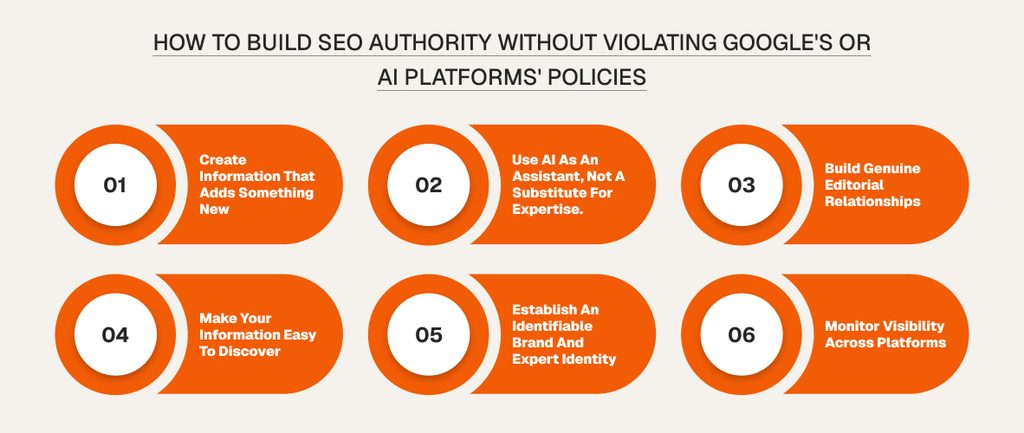
A common misconception is that AI search optimisation requires a completely new SEO strategy.
Google’s official guidance says otherwise. The fundamentals of SEO remain relevant to AI Overviews and AI Mode. Pages must meet the usual technical requirements, comply with Search policies and offer helpful, reliable information.
Here are the practices to prioritise.
Create Information That Adds Something New
Instead of rewriting existing articles, introduce original research, proprietary statistics, expert interviews, practical demonstrations or industry-specific analysis.
Use AI As An Assistant, Not A Substitute For Expertise.
AI can help with research organisation, outlining and editing. However, mass-producing pages without meaningful added value can violate Google’s scaled-content-abuse policies. Fact-check all AI-assisted material.
Build Genuine Editorial Relationships
Do not buy links to manipulate rankings or use automated link schemes. Google’s spam policies explicitly identify paid ranking links, excessive exchanges and automated link creation as link spam. Paid sponsorships and advertising should use appropriate link qualification, such as rel=”sponsored” or rel=”nofollow”.
Make Your Information Easy To Discover
Use descriptive headings, logical internal links, crawlable pages and appropriate structured data. Keep structured data consistent with visible content. Do not rely on supposed secret AI files or special schema as shortcuts to citations.
Establish An Identifiable Brand And Expert Identity
Provide accurate author profiles, organisation information, contact details and transparent editorial practices. Do not fabricate credentials or expertise.
Monitor Visibility Across Platforms
Do not assume that a website cited by ChatGPT will automatically be cited by Google AI Overviews or Perplexity. Evaluate each platform independently.
6. How Much Does It Cost To Build SEO Authority In 2027?
SEO authority is not built by purchasing a particular DA score. The investment goes into the people, content, technical improvements, research and relationships that establish credibility.
2026 pricing data provides a useful starting point for 2027 budget planning.
According to an Ahrefs survey of 439 SEO service providers, the average monthly SEO retainer was approximately $2,917. Agencies averaged $3,209, consultants $3,250 and freelancers $1,348. The survey also found that 68.8% charged $2,000 or less per month.
An Indian pricing benchmark published in November 2026, based on 53 SEO and AI-search proposals, reported a median monthly retainer of ₹75,000, with the middle half of quotes falling between ₹50,000 and ₹1,00,000.
These are market benchmarks, not mandatory budgets. Actual costs depend on competition, website size, the number of markets targeted and the amount of original content required.
Where Should You Allocate Your Budget?
An illustrative allocation for a business building SEO authority could look like this:
| Investment area | Suggested allocation |
| Content strategy and original research | 25% |
| Technical SEO and website improvements | 15% |
| Digital PR and editorial outreach | 25% |
| Topical content development and optimisation | 20% |
| Brand and AI visibility monitoring | 10% |
| Measurement and reporting | 5% |
Suggested planning allocation, not an industry-wide spending average. Adjust according to your website’s existing strengths and weaknesses.
The important point is to avoid spending the entire SEO budget on link acquisition. A website that invests in backlinks without improving its content, topical relevance and technical foundations may accumulate a stronger third-party score without establishing meaningful search authority.
7. Who Is Recognised As A Top SEO Authority?
There is no official global ranking of SEO authorities. Recognition depends on the subject being discussed.
For reliable SEO learning and research, distinguish between platform owners, measurement providers and independent industry publishers.
| Organization | Area of authority |
| Google Search Central | Official search documentation, policies and technical guidance |
| Moz | Domain Authority, Page Authority and SEO education |
| Ahrefs | Backlink analysis, keyword research and Domain Rating |
| Semrush | Competitive research, keyword intelligence and Authority Score |
| Search Engine Journal | SEO news, industry commentary and educational resources |
| Search Engine Land | Search industry reporting and analysis |
For beginners, Google Search Central should be the first reference for understanding what Google actually recommends and prohibits. Then use third-party tools to interpret performance and identify opportunities.
The distinction matters: an SEO tool can provide a useful authority score, but it cannot certify that Google considers a website authoritative.
8. The 90-Day SEO Authority Cheat Sheet: A Practical Plan For 2027
You do not need to overhaul your entire website in one month. A structured 90-day programme can help you identify gaps, establish topical depth and begin building measurable authority.
(Exclusive 3-month action plan)
Month 1: Audit And Establish Your Authority Baseline
DAYS 1–30 · DIAGNOSE BEFORE YOU BUILD
- Record your DA, DR and Authority Score as comparative baselines.
- Audit your backlink profile and identify irrelevant or suspicious links.
- Analyse your top competitors’ topical coverage.
- Identify three to five core subjects your website should own.
- Review your existing content for duplication and outdated information.
- Check indexing, crawlability, Core Web Vitals and internal links.
- Record branded and non-branded organic performance.
- Establish a baseline for AI mentions and citations across relevant platforms.
Month 1 outcome: A documented authority gap analysis and a prioritised SEO roadmap.
Month 2: Build Topical, Content And Brand Authority
DAYS 31–60 · CREATE REASONS TO TRUST YOUR WEBSITE
- Publish or substantially improve three core pillar resources.
- Create eight to twelve supporting articles across selected topics.
- Build contextual internal links between related pages.
- Add credible author profiles and editorial information.
- Publish at least one original research asset or data-led resource.
- Begin relevant digital PR and editorial outreach.
- Secure genuine industry mentions and partnership opportunities.
- Update important older pages with current information.
Month 2 outcome: Stronger topical coverage, improved content quality and the beginnings of a recognisable external presence.
Month 3: Strengthen External Recognition And Measure Progress
DAYS 61–90 · TURN CREDIBILITY INTO SEARCH VISIBILITY
- Continue earning relevant editorial backlinks.
- Expand content around queries where your website already receives impressions.
- Improve high-impression, low-CTR pages.
- Track changes in branded and non-branded search demand.
- Monitor rankings and clicks across your topic clusters.
- Test relevant prompts across ChatGPT, Perplexity and Google AI experiences.
- Record AI citations, brand mentions and source URLs.
- Review organic leads, enquiries and conversions.
- Compare all results against your original baseline.
Month 3 outcome: A measurable authority-building programme with evidence of what is working and where further investment is required.
Your 2027 SEO Authority Checklist
| Authority dimension | What success should look like |
| Link | More relevant, credible referring domains |
| Topical | Greater visibility across related subject clusters |
| Page | More important URLs earning qualified organic traffic |
| Content | Original, accurate and expert-supported resources |
| Brand | Growing branded search demand and industry recognition |
| Technical | Accessible, indexable and well-connected pages |
| AI search | More relevant brand mentions and citations across platforms |
Remember: 90 days is a practical implementation window, not a guarantee of ranking improvements or a fixed timeline for authority growth.
Search performance depends on competition, website history, content quality and the speed at which search systems discover and evaluate changes.