

Finding websites that accept backlinks is not particularly difficult. However, finding websites that are genuinely worth getting links from is much harder.
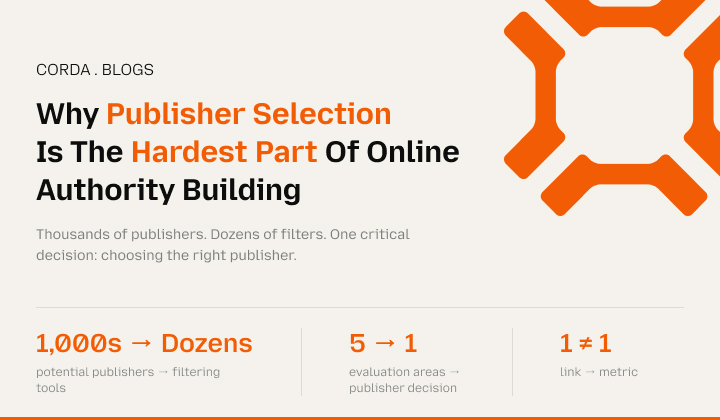
A link-building campaign can have thousands of potential publishers, dozens of filtering tools, and a long list of authority metrics. Yet the final decision often comes down to a few difficult questions:
- Is this website relevant to the business?
- Does its audience matter?
- Is the content trustworthy?
- Would a link from this publisher make sense?
- Can the publisher offer more than a metric in an SEO report?
- Is the opportunity worth the time, money, and risk?
These questions make publisher selection one of the most important parts of authority building in SEO.
The challenge is not finding a website with a high score. It is finding a website that makes sense for your brand, your audience, and the page you want to promote.
Publisher Selection Is Not The Same As Website Filtering:
Most link-building platforms let you filter publishers using criteria such as:
- Domain Rating
- Domain Authority
- organic traffic
- referring domains
- industry
- country
- estimated pricing
- publishing frequency
- link type
These filters are useful for narrowing a large database. But filtering is not the same as evaluating.
As a result, a website may meet every technical requirement and still be a poor publisher.
For example, a site might have a strong authority score but publish content across unrelated industries. It might receive search traffic but have no meaningful audience in your market. It might accept almost every topic and publish articles that feel disconnected from one another.
The website may look attractive in a spreadsheet. It may look much less convincing when you read five recent articles.
That is why publisher selection requires a second stage of human judgment.
The Right Publisher Depends On The Page You Want To Promote:
There is no universally good publisher.
A website that is suitable for a cybersecurity article may be irrelevant for a fashion brand. A business publication may work for a B2B software company but offer little value to a local restaurant.
Even within the same industry, the right publisher depends on the page being promoted.
Now, consider a company selling project management software. Different pages may need different types of publishers:
| Page being promoted | Potentially relevant publisher |
| Project management guide | Business or productivity publication |
| Software comparison | Technology or software review website |
| Industry research report | Specialist publication or research resource |
| Free project planning template | Resource page or productivity blog |
| Product announcement | Business news or industry publication |
| Customer success story | Industry-specific publication |
The publisher should fit the topic and purpose of the page, not just the general industry. A relevant domain is helpful. A relevant linking context is better.
Relevance Has Several Layers:
Relevance is often treated as a simple category.
As a result, a website is labeled “marketing,” “finance,” “health,” or “technology,” and the evaluation ends there. But relevance has multiple layers.
- Industry Relevance: Does the publisher cover the same broad field as your business?
- Audience Relevance: Does its readership include the people you want to reach?
- Topic Relevance: Does it publish content related to the specific subject of your page?
- Intent Relevance: Would your content help the reader solve the problem discussed on the linking page?
- Geographic Relevance: Does the publisher serve the market where your business operates?
So, a website can be relevant at one level and irrelevant at another.
For example, a general business publication may be relevant to a B2B software company. But a detailed article about enterprise API security may be better suited to a specialist technology publication.
Also, the more closely the publisher and page fit, the easier it becomes to justify the link.
Authority Metrics Are Useful, But They Cannot Make the Decision:
Metrics help SEO teams compare large numbers of websites. Moreover, they can highlight differences in backlink profiles, estimated traffic, or domain strength.
But they cannot fully measure:
- editorial credibility
- audience trust
- topical fit
- content quality
- brand suitability
- the usefulness of a specific placement
- whether the publisher has a real reason to mention your page
A website with a lower authority score may have a strong specialist audience and publish respected content.
Also, a website with a high score may have become a broad publishing operation with little editorial focus.
This does not mean metrics are useless. Instead, it means they should function as screening signals, not final verdicts.
A sensible process might use metrics to remove obvious mismatches, then rely on content and context to make the actual decision.
Read The Website Before You Buy Or Pitch:
This sounds obvious, but it is often skipped. A publisher’s homepage rarely tells you enough.
So, it’s best to read several recent articles and examine the topics covered, quality of the writing, depth of information, use of original sources, presence of author details, and even the publishing frequency.
Also, you can check out advanced parameters such as:
- the balance between editorial and commercial content
- the relationship between headlines and article substance
- whether articles appear written for readers or search engines
Look for patterns rather than judging one article. One weak article may be an exception.
A website filled with thin, repetitive, unrelated, or heavily promotional content presents a different problem.
The goal is to understand how the publisher operates.
The Website’s Content Mix Tells You A Lot:
A publisher’s content mix can reveal its priorities. Now, imagine two websites.
Website A publishes:
- detailed industry analysis
- interviews with practitioners
- original research
- useful tutorials
- carefully edited opinion pieces
Website B publishes:
- hundreds of unrelated commercial articles
- repetitive product roundups
- thin “best” lists
- generic content across dozens of industries
- frequent articles with almost identical structures
Both may offer a link.
But the first website gives you a stronger editorial environment. The second may make your placement look disconnected from the rest of the site.
This matters because a backlink does not exist in isolation. It appears alongside the publisher’s other content.
That surrounding environment affects how readers interpret the mention.
Check Whether The Publisher Has A Real Audience:
Traffic estimates can be useful, but they are not the same as audience quality.
A website may report substantial organic traffic while attracting visitors from countries, topics, or search queries unrelated to your business.
Ask:
- Where does the traffic come from?
- Which pages attract it?
- Are those pages relevant to your audience?
- Does the website have returning readers?
- Does it have an active newsletter or social presence?
- Do people engage with its content?
- Does the publication have a recognizable editorial identity?
You may not be able to verify every answer.
But even a basic review can reveal whether the publisher has a real audience or simply a collection of pages receiving search visits.
Also, a publisher with a smaller but relevant audience may be more useful than a larger website that reaches nobody important to your business.
Watch For Signs Of A Publisher Built Mainly For Links:
Some websites appear to be publications but function primarily as link-selling platforms.
No single sign proves that a website is low quality. However, several warning signs together deserve attention.
These may include:
- unrelated topics published under one domain
- unusually high publishing volume
- repetitive article formats
- vague or missing author information
- little evidence of editorial review
- articles written mainly around commercial keywords
- excessive exact-match anchor text
- large numbers of outbound commercial links
- pages that exist mainly to host external placements
- outdated or inconsistent site information
- a clear lack of audience or editorial identity
The key question is not whether the site accepts sponsored content.
Many legitimate publications do. The question is whether the site still provides a useful, credible environment for the reader.
A Publisher Can Be Legitimate And Still Be Wrong For You:
Not every unsuitable publisher is a bad publisher.
A respected regional newspaper may be valuable for a local business but irrelevant to a global software company.
Similarly, a specialist medical publication may be credible but unsuitable for a general consumer brand.
Also, a technology blog may have a strong audience but no reason to cover your particular product.
Publisher selection is not about creating a universal blacklist. Instead, it is about matching the opportunity to the business.
This distinction helps teams avoid rejecting good websites simply because they do not fit a narrow metric or category.
Price Should Be Evaluated Alongside Opportunity:
Publisher pricing can distort link-building decisions. A low-cost placement may look efficient when measured only by cost per link.
But it may require extensive editing, create little referral value, or place your brand on a website with weak relevance.
A more expensive publisher may offer:
- a closely matched audience
- stronger editorial standards
- better content distribution
- meaningful referral traffic
- a more credible brand association
- a useful relationship for future campaigns
This does not mean expensive publishers are automatically better.
It means price should be considered alongside the actual opportunity.
A useful evaluation asks:
- What audience can this publisher reach?
- What type of page will contain the link?
- How relevant is the topic?
- What editorial standards apply?
- Is the placement likely to remain useful over time?
- Does the opportunity support a broader campaign goal?
Cost is one data point, not the complete decision.
Publisher Selection Should Include A Risk Review
Every publisher carries some level of uncertainty.
SEO tools may have incomplete data. Traffic estimates may be inaccurate. Moreover, a website’s quality may change after you place a link.
Also, a publisher may alter its content strategy or remove older articles.
A basic risk review should consider:
- Editorial Risk: Does the site publish content that could weaken your brand association?
- Relevance Risk: Could the link appear forced or disconnected from the topic?
- Stability Risk: Does the website appear active and maintained?
- Commercial Risk: Are you paying for a placement without clear expectations about the page, link, or disclosure?
- Dependency Risk: Are too many of your links coming from the same publisher group or network?
The goal is not to eliminate all risk. Instead, it is to make the risk visible before committing resources.
Build A Publisher Evaluation Framework:
A consistent framework makes decisions easier across campaigns. In that case, you can evaluate each publisher across five areas:
| Evaluation Area | Questions To Ask |
| Relevance | Does the site and page fit the topic and audience? |
| Editorial quality | Is the content useful, original, and carefully maintained? |
| Audience | Does the publisher reach people who matter to the business? |
| Brand fit | Would the association support the brand? |
| Opportunity | Is there a realistic and useful reason for the link to exist? |
You can use internal scores if your team needs a repeatable process. But the score should summarize documented observations, not replace them.
For example, instead of recording only “high relevance,” add a note such as: Publishes detailed content for SaaS marketing teams and has covered related software categories in the past.
That explanation makes the decision easier to review later.
Use Different Standards For Different Link Objectives
Not every campaign has the same goal.
So, if your primary objective is referral traffic, audience fit may matter more than a high domain metric.
Similarly, if your objective is digital PR, editorial credibility and newsworthiness may matter most.
Also, if your objective is supporting a research report, the publisher should have a clear reason to cite original data.
Then, if your objective is local visibility, geographic relevance may be essential. TBH, publisher selection becomes easier when the campaign has a clear purpose.
Without a defined objective, teams tend to fall back on whatever metric the platform makes easiest to compare.
Reassess Publishers Over Time:
Publisher evaluation should not end when a link goes live. Websites change. Their topics may expand. Their editorial standards may decline. And their traffic sources may shift.
Also, their ownership may change, while older articles may be edited, redirected, or removed.
So, it’s always best to maintain a record of important placements and review them periodically.
In that case, you need to look for whether the link remains live, the page is still indexed, the article remains relevant, and whether the publisher’s content quality has changed.
Also, you should check whether the website still serves the intended audience and whether the relationship has produced other useful opportunities.
This is particularly important when a business relies on a large publisher network. A publisher database is not a permanent quality guarantee.
The Hardest Part Is Deciding What Not To Pursue:
A large publisher list creates pressure to use every available opportunity. But strong authority building often depends on rejection.
As a result, you may reject a website because:
- the audience does not match
- the topic would feel forced
- Or the content quality is inconsistent.
Similarly, you can also reject a site because the publisher’s commercial model is unclear, the brand association is unsuitable, and the placement offers little beyond a metric.
This is not wasted effort.
It is how a link-building team protects its time, budget, and website. A smaller list of well-matched publishers is usually easier to manage and easier to learn from.
Frankly, publisher selection is the hardest part of online authority building in SEO because the decision cannot be reduced to a single metric.
Moreover, authority scores, traffic estimates, topical categories, and pricing can help you narrow the field.
They cannot tell you whether a publisher is the right fit for your brand or the specific page you want to promote.
Additionally, that requires a closer look at the website’s content, audience, editorial standards, outbound links, business model, and overall context.
As a result, the most useful question is not ‘Can we get a link from this website?’ Instead, it is ‘Would this website be a credible and relevant place for our audience to discover this page?’
That question leads to better publisher decisions, more defensible SEO link building, and a strategy built around relevance rather than volume.