

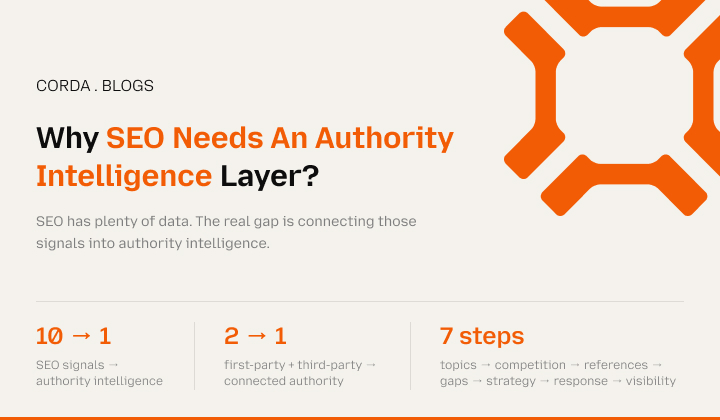
SEO has accumulated a lot of data.
You can track rankings, backlinks, referring domains, organic traffic, competitors, keywords, content performance, citations, brand mentions, and search visibility.
But having more data does not necessarily give you a clearer picture of authority.
The problem is that these signals usually live in separate tools.
Your backlink platform tells you who links to your competitors. Your rank tracker tells you where your pages appear.
Also, your content platform shows what you have published, while search data tells you what people search for.
Each dataset answers a useful question. Very few tell you how those signals connect. That gap is becoming more important as search expands beyond traditional blue links.
SEO for AI search requires brands to understand not only whether a page ranks, but whether the brand is recognizable, relevant, referenced, and supported by information across the wider web.
That is where an authority intelligence layer becomes useful.
What Is An Authority Intelligence Layer?
An authority intelligence layer is a system for connecting the different signals that contribute to how a website or brand is understood across search.
It sits above individual SEO datasets.
Instead of looking at backlinks, competitors, content, publishers, and search visibility separately, it connects them.
For example:
Your website
↓
Content and entities
↓
Competitor comparisons
↓
Publisher and referring-domain landscape
↓
Brand and topic mentions
↓
Search visibility
↓
AI-search visibility
The goal is not to create another authority score. Moreover, it is to understand why a brand has authority in some areas and lacks it in others.
That distinction becomes increasingly important when search systems need to decide which sources to surface, cite, summarize, or associate with a topic.
SEO Already Has An Authority Problem:
Traditional SEO often uses authority as shorthand for backlinks and domain strength.
That model was useful because links provided a measurable way to understand how websites were connected.
But authority has never been only about links. Also, a search engine can encounter signals about a brand through:
- its own website
- industry publications
- independent reviews
- expert commentary
- research citations
- news coverage
- partner websites
- community discussions
- structured information
- references from other authoritative sources
These signals do not all mean the same thing.
But together, they can help establish what a brand is known for and where it belongs within a topic.
Also, the challenge for SEO teams is understanding that broader picture.
AI Search Makes The Problem More Visible:
Traditional search usually gives you a list of results.
AI-powered search can provide a synthesized answer and identify sources used to support that answer.
And that changes the visibility question.
Moreover, a brand might rank for a keyword and still receive little visibility inside an AI-generated response.
Another brand might appear frequently in AI answers because its information is consistently represented across relevant sources.
This does not mean traditional rankings no longer matter. They still provide an important discovery channel.
But they are no longer the only visibility signal worth monitoring.
As a result, for SEO for AI search, brands increasingly need to ask, ‘where does our brand appear in the information ecosystem around a topic?’
Authority Is Distributed Across The Web:
Your website is only one part of your brand’s search presence.
So, imagine a company that publishes excellent content about cybersecurity. Its website contains detailed guides. Its technical SEO is strong. Its pages rank well.
But independent websites rarely mention the company.
Moreover, few industry publications cite its research. And its experts are rarely quoted.
Also, competitor comparisons barely include it, and other relevant websites do not reference its data.
The brand has strong first-party content. But its authority signals outside the website may be limited.
Now imagine another company with similar content quality that is also:
- cited by specialist publications
- mentioned in industry research
- referenced by relevant websites
- included in product comparisons
- quoted by journalists
- discussed by practitioners
The difference is not simply content quality. Instead, it is the network of evidence surrounding the brand.
Also, an authority intelligence layer helps make that network visible.
The Problem With Looking At Backlinks Alone:
Backlinks remain an important part of SEO. But a backlink database answers a relatively narrow question: ‘Who links to this website?’
In contrast, an authority intelligence asks broader questions:
- Who references this brand?
- Which competitors receive references that we do not?
- In what context?
- Which topics does the brand consistently appear around?
- Which publishers influence our category?
- Where are our authority gaps?
- Which pages attract external recognition?
That shift matters.
A brand might have thousands of backlinks but weak relevance within an important topic.
Another might have fewer links but strong recognition among the publications and organizations that matter to that subject.
Counting links alone cannot fully explain that difference.
Competitor Analysis Needs To Move Beyond Backlink Counts:
Competitors provide one of the richest datasets for understanding authority. But traditional competitor analysis often stops at:
- Domain Rating
- referring domains
- backlinks
- ranking keywords
- organic traffic
These numbers tell you where competitors are strong. But they do not always explain why.
Now, suppose three competitors repeatedly appear in articles about a specific topic. In that case, you need to know:
- Which publications mention them?
- What pages are being referenced?
- Which experts are being quoted?
- What research gets cited?
- Which topics do they own?
- Which publishers mention multiple competitors?
- Where does your brand appear instead?
- Which gaps are realistic to close?
That is a much richer competitive analysis. It turns competitor data into a map of the authority landscape.
An Authority Gap Is Not The Same As A Backlink Gap:
This distinction is important.
A backlink gap might tell you that a competitor has links from 50 websites you do not have links from.
Moreover, an authority gap asks why those websites recognize the competitor. For example, perhaps the competitor:
- published the original research
- created a widely used tool
- supplied expert commentary
- developed a strong category association
- became known for a specific topic
- built relationships with specialist publishers
You cannot always close that gap by acquiring 50 similar links. You may need to create a different source of evidence.
This is why authority intelligence should connect link data with content, topics, entities, competitors, and publisher relationships.
SEO For AI Search Requires Entity Clarity:
AI systems need to understand what information refers to. That makes clear entity relationships increasingly useful.
Moreover, a brand should be easy to associate with:
- its products
- its services
- related concepts
- its experts
- its industry
- original research
- its locations
- its areas of expertise
This does not mean adding keywords everywhere. Instead, it means making the relationship between those entities clear and consistent.
For example, if a company describes itself as a cybersecurity platform on its website but is consistently described elsewhere as a generic IT services company, the surrounding information is less consistent.
An authority intelligence layer can help identify these differences across sources.
First-Party Content Is Only One Side Of The Equation:
Your website gives search systems information about what you say about yourself. External sources provide evidence of how others describe and reference you.
Both matter.
This creates two broad categories:
1. First-Party Authority:
What your own website establishes through content, expertise, products, research, and structured information.
2. Third-Party Authority
What other websites establish through references, reviews, citations, interviews, research, mentions, and editorial coverage.
Neither should be treated as a substitute for the other.
A brand needs a clear identity on its own website and credible evidence of that identity elsewhere.
Publisher Intelligence Becomes More Important:
Once authority is viewed as a network, publishers become more than backlink targets. They become sources of market intelligence.
Moreover, a publisher can easily tell you which,
- topics receive editorial attention
- brands are frequently referenced
- experts are considered useful sources
- content formats attract citations
- competitors have established relationships
This changes how link-building teams approach publishers.
Instead of asking only “Will this website give us a link?” they can ask “What role does this publisher play in our industry’s information network?”
That is a much more strategic question.
Content Planning Can Use Authority Data:
Authority intelligence can also change how content is planned. Traditional content planning often starts with keyword research.
That remains useful.
But keyword volume alone does not tell you whether a brand has enough evidence to compete for a topic.
So, suppose a company wants to become visible for “enterprise cybersecurity.” Keyword research may show significant demand.
But competitor and authority analysis may reveal that established companies already dominate the topic across:
- search results
- specialist publications
- research reports
- expert commentary
- industry discussions
The response does not necessarily have to be “publish more articles.” The company might need to establish authority around a narrower subtopic first.
For example: Cloud access security → identity security → enterprise identity management
Additionally, the strategy becomes about building topical and external evidence over time.
Authority Intelligence Can Connect Content To External Recognition:
A common SEO reporting problem is that content production and link building are treated as separate activities.
One team publishes content. Another team acquires links. Then a better system can connect them.
For every important content asset, you could track:
- target topic
- search visibility
- competing pages
- referring domains
- publisher mentions
- external citations
- brand mentions
- AI-search appearances
- business outcomes
Now you can see which content is simply ranking and which content is becoming an externally recognized resource.
That distinction matters.
Additionally, a page that earns repeated independent references may have more strategic value than a page that temporarily ranks for a low-competition keyword.
AI Search Makes Measurement More Complicated:
Traditional SEO has relatively familiar measurements. You can track rankings, impressions, clicks, and traffic. However, AI search introduces additional questions.
For example:
- Does the brand appear in AI-generated answers?
- Which topics trigger those appearances?
- Which sources are cited?
- Are competitors cited instead?
- How frequently does the brand appear?
- Is the brand described accurately?
- Which pages or external sources seem connected to those mentions?
There is no single universal metric that captures all of this. That is precisely why an intelligence layer is useful.
The objective is not to replace traditional SEO metrics. Instead, it is to put different visibility signals into the same strategic context.
What an Authority Intelligence Workflow Could Look Like
A practical workflow might look like this:
Step 1: Define The Topics That Matter
Do not try to measure everything. Start with the topics connected to your products, customers, and commercial priorities.
Step 2: Map The Competitive Landscape
Identify the brands consistently visible across those topics.
Step 3: Analyze External References
Look at backlinks, citations, mentions, reviews, research references, and relevant publisher coverage.
Step 4: Identify Authority Gaps
Find areas where competitors have strong external evidence but your brand has limited representation.
Step 5: Understand The Reason Behind The Gap
Is it missing content? Missing relationships? Missing expertise? Missing research? Weak brand positioning?
Step 6: Choose The Right Response
The solution might be content, digital PR, expert contributions, original research, publisher outreach, technical improvements, or stronger entity signals.
Step 7: Monitor Visibility Over Time
Track changes across traditional search and AI-search environments.
This creates a feedback loop. How? Because data informs strategy, strategy creates new evidence, and new evidence changes visibility.
The resulting data informs the next decision.
The Goal Is Not Another Authority Score:
This is perhaps the most important distinction.
SEO already has plenty of scores.
- Domain Authority.
- Domain Rating.
- Page Authority.
- Visibility scores.
- Traffic estimates.
- Keyword difficulty.
An authority intelligence layer does not need to create another number and declare that a website has “82 authority.”
That can make a complicated system look simpler without making it more understandable. As a result, the better goal is to explain:
- Where is this brand authoritative?
- Why does it appear authoritative there?
- Where is it underrepresented?
- Which competitors have stronger evidence?
- What could realistically change that?
Those answers are more useful than another score.
Authority Intelligence Is About Connecting Evidence
The web contains a huge amount of information about every established brand. The challenge is connecting it.
Moreover, tbh, a brand’s own content tells one story. Its backlinks tell another. Competitor coverage reveals another.
Then, publisher relationships add another layer. More importantly, search visibility provides another, while AI-generated answers and citations add yet another.
Looking at each separately creates fragmented SEO. Connecting them creates intelligence. That is the real purpose of an authority intelligence layer.
Frankly, SEO is becoming less about optimizing isolated pages and more about understanding how a brand is represented across an interconnected information ecosystem.
That shift is particularly important for SEO for AI search, where visibility can depend on whether a brand, topic, product, or expert is consistently represented across multiple sources.
The answer is not to abandon traditional SEO. Rankings, technical health, content, links, and search demand still matter.
Instead, the opportunity is to connect them.
An authority intelligence layer gives SEO teams a way to move from “What happened to our rankings?” to “What evidence supports our authority, where are the gaps, and what should we do next?”
That is a much more useful question for modern search.