

Your competitors already have a list of websites that consider their content worth citing. You probably don’t have that list.
And that’s fine. You can build one by reviewing the websites that have linked to your competitors but haven’t linked to you.
In SEO, this is often called a link gap or backlink gap. But the useful part is not the gap itself. It is what the gap tells you about your market.
A competitor website analysis can show which publishers, organizations, blogs, directories, and industry resources already link to businesses like yours.
Those websites give you a much more relevant prospect list than a random database of sites accepting backlinks.
And the trick here is to understand what you can do with all the data at yout disposal once you get your hands on it.
On that note, this blog will break down competitor website analysis in detail and highlight how you can find websites that have linked to competitors but haven’t linked to you.
Stay tuned.
What Is A Competitor Link Gap?
A competitor link gap is the group of websites linking to one or more competitors but do not link to your website.
For instance, let’s assume you are the founder of a digital marketing agency. Now you analyze five of your competitors and find out that 50 websites link to at least three of them.
Strangely, none of those 50 sites link to you. Understand that those 50 websites do not become yout backlink opportunities automatically.
Some of those sites might have linked to your competitor because of some specific research report, news story, or product review they have published.
And that distinction matters.
So understand that a link gap tells you where your competitors have earned attention. However, it does not tell you that every website in the gap should be contacted.
This is why competitor website analysis should come before outreach.
Why Competitor Backlink Analysis Is More Useful Than a Giant Prospect List?
A typical link-building list might contain thousands of websites. The problem is that most of them have no obvious reason to link to you.
Competitor backlink analysis starts with an existing relationship between a publisher and your market.
Moreover, a website that already links to several competitors has demonstrated at least one of these things:
- It covers your industry.
- It references businesses like yours.
- The site publishes content relevant to your audience.
- The site is willing to cite external sources.
- It has mentioned your competitors for a specific reason.
That makes the data more useful.
As a result, you are not asking, “Who might accept my link?” Instead, you are asking, “Who already finds information in my category useful enough to reference?”
That is a much better starting point.
How To Do Competitor Website Analysis?
In this section, let’s explore how you can find out which websites have linked to your competitors and not to you – this is the backbone of your competitor website analysis.
So, let’s get started!
1. Start With The Right Competitors:
The quality of your analysis depends heavily on the competitors you choose. Do not automatically enter the three biggest companies in your industry.
Instead, choose competitors that resemble your own search position. On that note, look for websites that:
- compete for the same important keywords
- target the same audience
- publish similar types of content
- operate in the same market
- have comparable products or services
- appear alongside you in search results
Also, you can include one larger competitor to identify opportunities outside your current reach. Three to five competitors are usually enough for a useful first analysis.
2. Use A Backlink Gap Tool:
If you have used any SEO tool or platform, you know that most tools offer some feature for doing competitor backlink analysis.
And if you are new to do this, then let us break it down for you – you need a backlink gap tool; otherwise, you will be aiming in the dark. And that can hold your site back from performing.
Now, the thing about these tools is that the interface varies. But the process is broadly the same.
Enter your website and several competitors. Then, the tool compares their backlink profiles and identifies referring domains linking to competitors but haven’t linked to you.
You will usually get something resembling this:
| Referring domain | Competitor A | Competitor B | You |
| Industry publication | ✓ | ✓ | — |
| Marketing blog | ✓ | — | — |
| Research website | ✓ | ✓ | — |
| Local business directory | — | ✓ | — |
| University resource | ✓ | ✓ | — |
Also, note that the most interesting rows are often the ones where multiple competitors have links from the same domain.
One competitor getting a link could be an isolated event.
Three competitors getting links from the same publication suggests a stronger relationship between that publication and your industry.
That is a useful signal.
3. Find The Websites Linking To Multiple Competitors
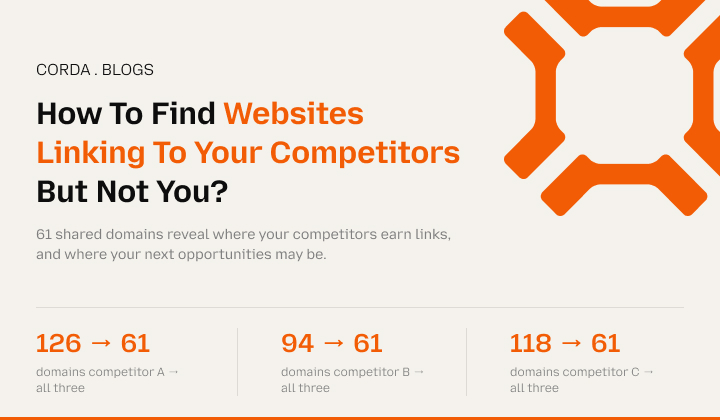
This is where competitor website analysis becomes particularly useful. So, suppose you compare four competitors and find:
- 126 domains link to Competitor A
- 94 domains link to Competitor B
- 118 domains link to Competitor C
- 61 domains link to all three
Those 61 domains deserve closer attention. Why? Because the publisher has already demonstrated interest in your category more than once.
But don’t treat “links to all three competitors” as an automatic outreach list. Instead, open the pages and find out why each competitor was mentioned.
You may discover that the website:
- cited a competitor’s original research
- reviewed a product
- included the company in a comparison
- quoted an executive
- referenced a useful tool
- listed industry resources
- covered a company announcement
- included the competitor in a local directory
- mentioned the company as part of a partnership
The reason behind the link determines whether there is an opportunity for you.
4. Investigate The Actual Linking Page:
A referring domain is only the beginning.
Click through to the page that contains the backlink. This step can completely change your interpretation of the data.
Imagine finding a high-authority marketing publication linking to your competitor. At first glance, it looks like a valuable prospect.
Then you inspect the article. The competitor was mentioned because its founder provided an expert quote.
You cannot recreate that exact link by sending a generic guest-post pitch.
Instead, you might need to become a source for future articles, publish original research, offer expert commentary, or build a relationship with the journalist.
The backlink is evidence of an opportunity. The linking page tells you what kind of opportunity it is.
5. Separate Link Opportunities By Reason:
Do not put every competitor backlink into one spreadsheet column called “Outreach.” Instead, classify the reason behind the link.
A practical system might look like this:
| Link type | What it tells you | Possible action |
| Resource page | Publisher curates useful resources | Create something genuinely useful |
| Original research | Data attracted citations | Publish proprietary research |
| Expert quote | Competitor supplied expertise | Offer relevant subject-matter expertise |
| Product review | Publisher evaluates products | Explore review opportunities |
| Comparison | Publisher compares solutions | Improve comparison visibility |
| Guest article | Competitor contributed content | Pitch a genuinely useful article |
| Directory | Industry listing exists | Check whether a legitimate listing is relevant |
| Partnership | Business relationship exists | Look for partnership opportunities |
| News coverage | Competitor generated a newsworthy event | Develop newsworthy company stories |
This prevents the classic mistake of treating every backlink as a guest-post target.
6. Check Whether You Already Have A Relationship:
Before contacting a website, check your own backlink profile carefully. You may already have a link from the domain.
Perhaps it points to an old article. Perhaps it is a nofollow link. Or perhaps the competitor received a link to a different page.
Your goal is not simply to increase the number of referring domains. Instead, your goal is to identify useful gaps in your existing authority profile.
7. Look For Content-Level Gaps:
A competitor link gap can reveal more than missing referring domains. It can reveal missing content assets.
So, suppose five competitors have earned links to original statistics pages about your industry.
You do not necessarily have a publisher problem. You may have an asset problem. The market has something worth citing, but your website does not yet offer an equivalent resource.
Moreover, the same thing can happen with:
- original studies
- industry benchmarks
- calculators
- research reports
- datasets
- visual guides
- expert commentary
- detailed comparisons
- proprietary tools
This is one of the most valuable insights you can get from competitor website analysis.
Sometimes the right response to a backlink gap is not outreach. It is creating something worth linking to.
8. Analyze The Anchor Text Carefully:
Anchor text can help explain the context behind a competitor’s backlink. So suppose several websites link to a competitor using phrases such as:
- “2026 industry statistics”
- “SEO benchmark report”
- “free keyword research tool”
That gives you clues about what those publishers found useful. But don’t copy the anchor text and build a page around it just because it appears frequently.
Anchor text is evidence about the linking context, not a content brief.
So, it’s best to look at the surrounding paragraph and the page itself. Ask what the publisher was trying to help its reader understand.
That is usually more informative than the anchor text alone.
9. Don’t Ignore Competitor Links You Cannot Replicate:
Some backlinks are useful precisely because they tell you what not to pursue. A competitor may have hundreds of links from:
- old partnerships
- sponsorships
- company acquisitions
- personal relationships
- press coverage
- awards
- discontinued campaigns
- industry memberships
You cannot recreate every link through SEO. And you do not need to. TBH, the purpose of competitor analysis is not to reproduce another website’s backlink profile.
Instead, it is to understand the kinds of recognition and references that exist within your market.
10. Turn The Analysis Into An Outreach List:
Once you have reviewed the domains, build a smaller prospect list. Now, for each prospect, record:
- Website: The referring domain.
- Linking page: The exact page where the competitor appears.
- Competitor mentioned: Which competitor received the link.
- Link reason: Why the publisher linked to them.
- Relevant page on your site: The page that could genuinely add value.
- Opportunity type: Resource, research, expert quote, comparison, guest contribution, partnership, and so on.
- Relevance: How closely the website matches your audience and topic.
- Priority: Your internal assessment based on relevance, credibility, and realistic opportunity.
This turns a backlink export into an actual marketing workflow.
11. Find The Pattern Across Competitors:
The most interesting finding may not be a single website. It may be a pattern. So, imagine your analysis shows that competitors repeatedly earn links from:
- SaaS comparison websites
- industry research publications
- marketing newsletters
- university resources
- specialist blogs
- software directories
That tells you something about how authority is built in your category. Then you can ask a more useful question: What does our market consider worth citing?
Maybe competitors win links because they publish original data. Maybe they have strong founder visibility. Or maybe they create useful tools.
The backlink gap can expose the strategy behind the links. And that is far more valuable than a spreadsheet of domains.
The Goal Isn’t To Copy Your Competitors
Competitor backlink analysis can easily become a copying exercise.
Your competitor has a link from a website, so you want the same link. Your competitor published a statistic, so you publish a similar statistic.
Also, if your competitor wrote a guest post, you pitch the same publication.
That approach misses the bigger opportunity. The real question is: Why did that website have a reason to mention your competitor?
Once you understand that reason, you can decide whether you can create an equally useful reason for the publisher to mention you.
Sometimes that means better content. Sometimes it means original research. And sometimes it means deciding that the opportunity is not worth pursuing.
That is what makes competitor website analysis useful. It turns other companies’ backlinks into market intelligence, rather than just another list of URLs.
Finding websites that have linked to your competitors but not you is relatively easy. Most major SEO platforms can identify the gap in a few clicks.
The difficult part is interpreting it correctly.
Moreover, a competitor backlink does not automatically mean you need the same link. It tells you that a publisher, organization, or website had a reason to reference that competitor.
Find that reason.
Then ask whether you can create a stronger, more relevant, or genuinely different reason for them to reference you.
That approach produces a smaller prospect list, better outreach, and a competitor website analysis that actually informs your SEO strategy.
Read Also: